
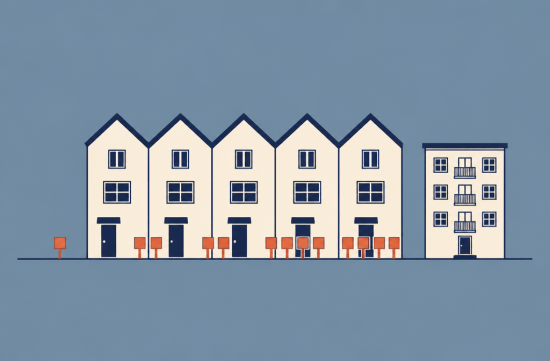
Last week, a friend called me. They've been renting in Annandale for a few years and were unsure whether to buy a townhouse this fall or wait another year.
This kind of question shouldn't be answered on a whim, so in this article, I plan to follow their situation and check the numbers one by one. The reference point is mid-November.
First, there's something to clarify. As of the time I'm writing this, the official October figures have not yet been released.
The Northern Virginia Association of Realtors (NVAR) typically publishes monthly statistics around mid-next month, so the most recent confirmed data available is from September. I will summarize the October numbers separately once they are out.
Let's look at the September statistics released by NVAR on October 16. The median sales price for all of Northern Virginia is $744,950, which is a 4.2% increase from a year ago.
However, transactions moved in the opposite direction. The number of transactions in September was 1,250, down 7.5%, and pending contracts were 1,204, down 16.2%.
The most noticeable change was in inventory. Active listings in September were 3,477, up 30.7% from a year ago, and the months of inventory rose to 2.5 months.
The increase in inventory varied significantly by type. Condo and townhouse inventory rose by 49.7%, while single-family homes only saw a 5.7% increase.
At this point, the voice on the other end of the phone brightened a bit. The house they want to buy is a townhouse.
Narrowing it down to Fairfax County makes the picture clearer. According to a report by FFXnow citing preliminary data from Bright MLS, there were 897 transactions in the county in September, down from 953 a year ago.
The average sales price was $903,940, up 3%. However, this is largely influenced by the average price of single-family homes, which is $1,220,641, up 2%.
The average price for attached homes, which includes townhouses and condos, was $569,805, down 0.8%. When looking at condos alone, the average price was $421,643, down 10.3%.
The active inventory in the county was 2,326 at the end of September, a 36% increase, and it took an average of 26 days to go under contract. This is slightly longer than the five-year average of 22 days for September.
Finding monthly official statistics specifically for Annandale was challenging. For reference, TopHap's early August report indicated that the median sales price for the 22003 zip code over the past 12 months was $781,000, a 2.4% increase from the previous year.
Since it's a neighborhood with a high proportion of single-family homes, the prices for single-family homes seem to be holding steady, similar to the county trend. In contrast, townhouses and condos have definitely seen more room for negotiation than before.
Now it's time to look at the rental side. According to RentCafe's data as of November 1, the average rent in Annandale is $2,212, nearly the same as $2,217 a year ago.
By bedroom count, the rents are $1,938 for a one-bedroom, $2,321 for a two-bedroom, and $2,822 for a three-bedroom. This indicates that rents have essentially remained flat over the past year.
However, rental statistics can vary significantly by site. Zumper, which is based on listings, reports an average of $2,550 for the same period, so it's best to compare the actual market rates directly.
The last variable is interest rates. According to Freddie Mac's weekly survey, the average for a 30-year fixed mortgage was 7.18% as of November 5.
This marks a decrease for three consecutive weeks, following rates of 7.32% on October 22 and 7.24% on October 29. Still, compared to a year ago at 6.22%, it's nearly a full percentage point higher.
Lisa Sturtevant, chief economist at Bright MLS, also pointed to interest rates as a more pressing factor affecting the local market than federal government layoffs. The number of home showings in the Washington DC area has also decreased by 16.9% compared to a year ago.
When applying the numbers to their situation, it looks like this: the current rent for their two-bedroom is nearly unchanged after a year, while the townhouse they want to buy has seen an increase in inventory, causing prices to slightly dip.
However, due to the 7% interest rate, even if home prices drop a bit, the monthly payment burden is greater than it was a year ago. This means that even a small decrease in home prices could be offset by the difference in interest rates.
So, I advised them not to rush and to use this winter as a negotiation season. They should focus on townhouses that have been on the market for a while and consider asking for seller-paid closing costs or a rate buy-down.
If their lease renewal is approaching, the fact that rents haven't increased can also be a negotiation card. Instead of insisting on a one-year lease, it might be worth asking if there are options for shorter-term leases.
One more thing to add is that these decisions can vary greatly depending on income and down payment size. I recommend checking with a loan officer about pre-approval amounts before making any final decisions.
You can check the official October statistics on the NVAR website's news page around mid-month. Once the numbers are out, I'll revisit whether the trends from September continue.
Personally, I believe this is the first time in years that buyers have a bit of breathing room. However, I also want to remind you that this breathing space is still limited due to interest rates.
 Hennesix
 SalmonSquats








 B.I.G. Victor |

 Amber H |
 uplifted |

 Dr. Kelso |

 silents |

 American Politician Community |

 Next Year, Let's Become Rich |


 U.S. Weather Bureau News |

 Great TOWN NEWS |
 action blog 101 |
 athome blog |
 calvor |
 Haha and Bomi Blog |
 Lee Ton |
 viba viba |
 Olivia's Blog |
 208 Master |
 crumb |
 Burbank Lee |
 tervox95 |
 silverado |
 Grow Your Gut Bacteria Well |
 Kim You Shin |
 Squid Q |
 gelatonew |
 river9 |
 ttano |
 Eagle in America for Five Years |