
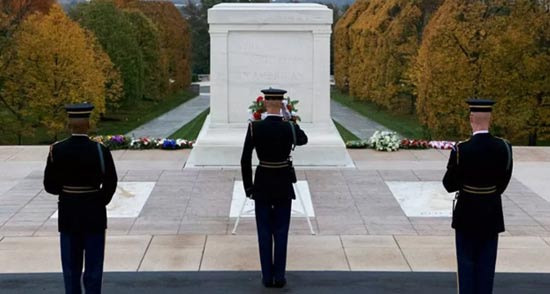
The story of Arlington National Cemetery dates back to the colonial period of Virginia. Daniel Parke Custis, one of the wealthiest men in the colony, owned vast plantations in Virginia, and after his death in 1757, this land was inherited by his wife, Martha Custis. However, two years later, in 1759, Martha remarried George Washington, one of the most famous figures in American history. Thus, the plantation naturally became Washington's property and later became known as 'Arlington House,' leaving a deep mark in American history.
When Martha Washington passed away in 1802, her grandson George Washington Parke Custis inherited the plantation. He did not use it merely as a farm but transformed it into a symbolic place to preserve and honor the legacy of his grandfather, George Washington. As time passed, when he died in 1857, the land was inherited by his only daughter, Mary Anna Custis Lee, and her husband, Robert E. Lee. Thus, Arlington House became a land where the names of two historically significant figures, the first President of the United States and the Confederate General during the Civil War, intersected.
However, the outbreak of the Civil War in 1861 dramatically changed the fate of this land. As General Robert E. Lee and his sons joined the Confederate Army, Arlington was recognized as a strategic point by the Union Army due to its location directly across from Washington D.C. Ultimately, the Union Army occupied Arlington, and Mary Anna had to flee to southern Virginia due to her deteriorating health. Thus, the Lee family's plantation fell into the hands of the federal government.
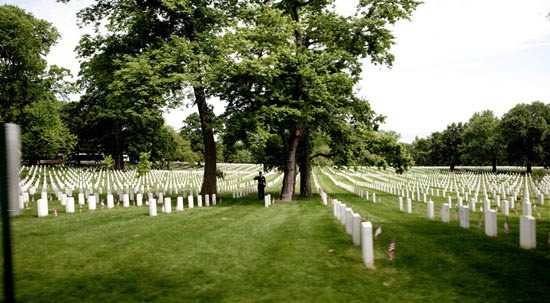
As the war dragged on and casualties increased sharply, the federal government faced the need to establish a new military cemetery near the capital. Montgomery C. Meigs, then the Army Quartermaster, recalled General Lee's Arlington plantation while searching for a suitable site near Washington. He deemed it a perfect location for the burial of the fallen and proposed to President Abraham Lincoln to seize the land.
In fact, there was a perception within the federal government that this was a "warning measure against the Lee family" due to Lee's refusal to comply with the Union's request and his joining the Confederacy. In 1864, the government officially purchased the Arlington land for $26,800, and it soon transformed into a cemetery for Union soldiers who sacrificed their lives in the war. Today's Arlington National Cemetery is that very place.
Afterward, Mary Anna attempted to negotiate with the government through an agent, claiming the acquisition process was unjust, but the government ignored her. Ultimately, after Mary Anna passed away in 1874, her eldest son Custis Lee filed a lawsuit.
In 1882, the Supreme Court ruled 5 to 4 that "the federal government seized private property without due process," returning the land to the Lee family. However, since many fallen soldiers had already been buried there, Custis Lee made a practical choice instead of reclaiming the land. In 1883, he negotiated with then-Secretary of War Robert Todd Lincoln (son of Abraham Lincoln) to sell the land back to the government for $150,000, thus officially making Arlington federal property.
For Americans, Arlington National Cemetery is not just a cemetery but is regarded as the 'conscience of the nation' and a 'symbol of sacrifice.' Those buried here are all individuals who dedicated themselves to the country, and visitors often say that they feel 'freedom is not free' as they walk through this place.The quiet hills and the endless rows of gravestones encapsulate the history of wars that America has endured. Not only active-duty soldiers but also their families regard this place as a 'sacred site.' The sound of the bugle on funeral days and the sight of the folded American flag always touch the heart.
Many Americans do not see Arlington merely as a place to honor the dead. It is a place that reminds us "who we are and on what sacrifices our country was built." Therefore, those who visit this place bow their heads with reverence and silently express their gratitude.







 nivex85 |
 yentra |
 Virginia Butterfly Mom |
 Kondae Garusong Blog |
 laro90 |
  MEDBIO American Doctor Blog |
  SWAT TEAM BLK |
  DREAM BIG |
  frostbite |
  330 Forever My Love |
  El Dorado |
  dralix58 |
  Gorama Round |
  Skydiving |
  dreamport |
  Yellow Snowman |
  Toaster Pizza Magic Show |
  velvetnom |
  Anytime Journey |
  Mrs. Duluth |
  jaxter |
  Atlanta Mama |
  Baguette Blog |
  Tan Sol |