

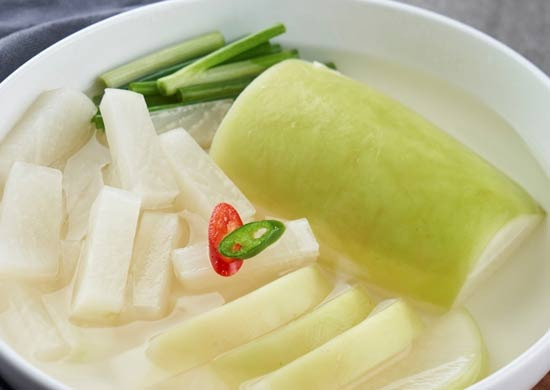
Living in Las Vegas, even a short trip outside in the summer can leave you feeling hot and lose your appetite.
So, whenever I find fresh radishes at the store, I make sure to buy them to prepare dongchimi.
Having a jar of well-fermented dongchimi in the fridge is great for side dishes, and you can even make refreshing dongchimi noodles, making it a must-have summer food.
Dongchimi seems simple to make with easy ingredients and methods. However, it can be surprisingly tricky when you actually try to prepare it.
If it's too salty, it's not good, and if it's too bland, it doesn't taste right. If it ferments just a little too long, it can quickly turn sour.
That's why I've been using the same method for years, and it has become my family's favorite recipe.
First, prepare one radish and cut it into pieces about 1.5 cm thick, then slice it into long pieces about the thickness of your pinky finger.
It's best not to peel the radish since the skin contains many nutrients.
Instead, just scrub it clean with a soft sponge to remove any dirt.
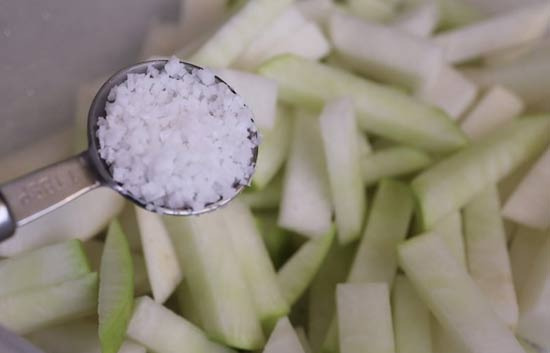
Place the radish in a large container and sprinkle 2 tablespoons of sea salt evenly over it, then let it sit for about 1-2 hours to brine.
Turning it over once or twice during this time will help the salt distribute evenly.
Make sure not to discard the radish juice that comes out; you'll need it later to make the dongchimi broth much cooler.
While the radish is brining, put half an onion, half a pear, 10 cloves of garlic, one piece of ginger, and 100ml of water into a blender and blend until smooth.
Place the blended ingredients in a cloth and mix it into 2 liters of water to create a clear and clean broth.
In this, dissolve 2 tablespoons of sea salt in 50ml of warm water, and add half a teaspoon of new sugar, mixing well.
If you're hesitant about using new sugar, you can substitute it with sweeteners like stevia or green sweet, which work just fine.
Even a small amount enhances the natural sweetness of the radish.
Now, lay some green onions at the bottom of the kimchi container. Add the brined radish along with the radish juice, then add half a pear and both red and green chili peppers.
For the peppers, just cut them in half and shake out the seeds to let a mild spiciness infuse.
Use the pear with the skin on, but soaking it in vinegar water for about 20 minutes before adding it will make it safer to eat.
Finally, pour in the prepared dongchimi broth, and you're done. The process is really simpler than you might think!
However, the fermentation time is what determines the flavor.
In summer, let it ferment at room temperature for about one to two days, and if it's winter and the temperature is low, let it ferment for about three to four days before putting it in the fridge for the best taste.
Well-fermented dongchimi has clear, cool broth with a very clean finish. I often make dongchimi noodles by mixing boiled somen noodles in this broth.
In the hot summer of Las Vegas, it's even cooler and easier on the stomach than cold noodles, and my husband and kids really enjoy it when I serve it with bulgogi.
If you find firm and fresh radishes at the store, don't just pass them by.
Even just one jar will allow you to enjoy a cool meal and dongchimi noodles throughout the hot summer.
 CandyTiger
 UrbanSummit71
 NightVibe






 Karina's Blog |
 Texas Real Estate Blog |
 Seattle - Emerald City |
 Yahoo LALA |
 Ishiyoung Forever 208 |
  vegas mom |
 korvix |
 US Legal Consultation on Trials |

 novapixel |
  Idaho's Sumi's House |
  Mr. Midwest America |
  wildfire |
  legalway |
  postcard |
  cheesecake07 |
  My Miami Stories |
  windylotus |
  Mia Flori |
  velaro29 |
  velaro |
  foxtrot83 |
  moname |
  mapleline |
  UNI Lover |
  California Dreamer |
  Choco Mint Creator |