

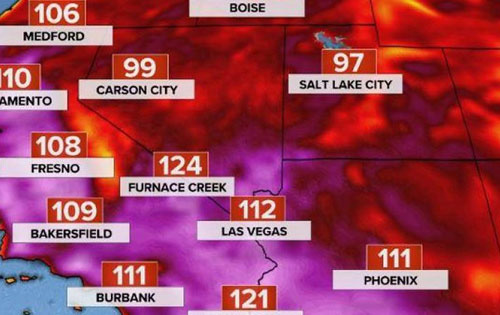
People who have experienced a summer in Las Vegas often say the same thing.
"This isn't just hot; it's dangerous." In fact, from June to August, it's common for daytime temperatures in Las Vegas to exceed 110 degrees Fahrenheit (about 43 degrees Celsius), with heat advisories issued repeatedly. The problem is not just that it's hot; this temperature range itself poses a threat to human life.
In such extreme heat, the body's temperature regulation begins to fail. The human body needs to maintain a stable temperature of about 36.5 to 37 degrees Celsius to function properly. When external temperatures rise too high, the body tries to cool itself through sweating. However, in a high-temperature environment like Las Vegas, the rate at which sweat evaporates is slower than the rate at which heat accumulates in the body. This is especially true if hydration is inadequate or if one is exposed to direct sunlight without shade for extended periods.
If body temperature rises above 38 degrees Celsius, one enters the stage of heat exhaustion, and if it exceeds 40 degrees, it can progress to heat stroke. At this stage, it's not just uncomfortable; brain function begins to be directly affected. Confusion, dizziness, and impaired judgment can occur, and in severe cases, one may lose consciousness. The more dangerous aspect is that sweating may stop in this state, meaning the body can no longer cool itself.
To understand why rising body temperature can be fatal, the key lies in the breakdown of proteins and organ function. The enzymes and proteins in our bodies only function normally within a certain temperature range. When body temperature rises excessively, the structure of proteins is altered, leading to loss of function. In simple terms, the body's systems begin to fail one by one. The brain, in particular, is very sensitive to heat, and prolonged high temperatures can damage nerve cells. At the same time, the heart and kidneys enter a state of overload, blood pressure becomes unstable, and organ damage progresses rapidly.
In Las Vegas, there are actual cases of death each year due to extreme heat. Most of these occur when individuals do not hydrate sufficiently during outdoor activities, stay in vehicles for too long, or are elderly or have underlying health conditions. Notably, the temperature inside a vehicle can rise above 140 degrees in just a few minutes, so even a moment of inattention can lead to a life-threatening situation.
What's important in this region is to abandon the mindset of "just tough it out."
Heat is not something to endure; it is a risk factor that must be managed. Avoid outdoor activities during the hottest parts of the day, and if your body shows any signs of distress, move to a cool place immediately.
The summer in Las Vegas, true to its desert environment, can be life-threatening if one is not aware and cautious.
 EmptyAccount
 CaffeinLvl
 OmingOming
 ChickSkinLab
 PeterPedro







 LIZ Legal Information Blog |
 Karina's Blog |
 Jimbeam 88 |
 Taco Bell Candy Note Blog |
 Splendid Mission |
 Anova US Beauty Information |
  celion78 |
 US Legal Consultation on Trials |
 korvix |
 vegas mom |
  Cap Com |
  nixxon |
  kevin Kim |
  beerdreamer |
  Kims Spring |
  White bunny |
  Kansas City Representative Singer |
  shadow 007 |
  sun walker |
  Choco Choco Star |
  midnight blue |
  honeypot |
  summer |
  adventure77 |
  flexible |
  Shintongbangtong Shin Naerin James Park |
  truepixel |
  Kathy's Blog |
  Hae Naem |
  quatspace |