
Recently, I spoke with a couple approaching retirement.
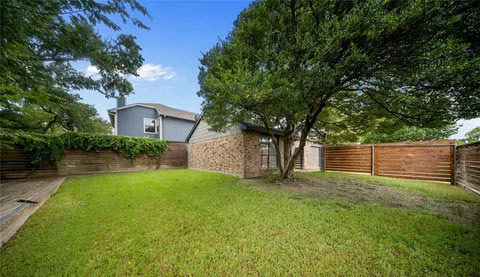
They have lived in a single-family home in North Dallas for nearly 20 years, but surprisingly, their biggest concern is the yard.
When they were younger, mowing the lawn and trimming trees on weekends was enjoyable. However, as they age, the situation has changed.
Working outside for an hour or two in the Dallas summer is no longer a simple task. Yet, hiring someone feels like a waste of money each month.
Thus, the dilemma began. "Should we keep this big house? Or would it be better to move to a townhome or condo?"
This is a valid concern for anyone nearing retirement.
The advantages of a single-family home are clear. There's a yard, ample space, and privacy from neighbors.
When children visit with grandchildren, there's no worry about room availability. The problem is that I have to manage all that space myself.
It's not just the lawn that's an issue. If the air conditioning breaks one day, it could cost thousands of dollars, and when it's time to replace the roof, it will require even more money.
As plumbing, fences, and exteriors start to fail one by one, these costs can feel burdensome after retirement.
That's why many people are looking into townhomes.
Townhomes offer a way to maintain some of the feel of a single-family home while reducing the burden of yard and exterior maintenance.
However, you have to pay HOA fees. In the Dallas area, you might expect to pay around $200 to $300 a month, with some communities charging even more.
At first, you might think, "It feels wasteful to pay $300 a month for maintenance fees."
But considering the costs of hiring lawn care services, roof and exterior repairs, and various maintenance fees for a single-family home, it's not necessarily a waste.
You could think of it as paying a fixed amount each month to take on a significant portion of the management.
Condos are even more convenient. Especially if they have elevators and no stairs inside, the benefits increase as you age.
For retirees who travel frequently, it's also convenient. You can lock the door and leave without worrying about the yard.
However, HOA fees for condos are often higher than for townhomes. It's common to find places that exceed $400 a month, and luxury condos can be much more expensive.
Utility costs are another consideration. Cooling a single-family home with four or five rooms in the Texas summer is bound to be more expensive than cooling a smaller townhome or condo.
If the children have all moved out and it's just the couple living there, running the air conditioning all day for unused rooms adds to the costs.
Property taxes are also significant. Texas has no state income tax, but homeowners face a considerable property tax burden.
Fortunately, there are additional exemptions related to Homestead for homeowners over 65, and programs that limit school property tax burdens, which are worth checking out if you're nearing retirement.
Additionally, active senior communities for those over 55 are becoming an option.
These communities offer amenities like pools, fitness centers, and clubhouses, and the advantage of living among people of similar ages.
However, as these amenities and management services increase, so do the monthly costs.
Ultimately, there's no right answer.
If it were me, I wouldn't just look at the home price when deciding on a house before retirement.
I would consider whether I can manage the yard for the next ten years, whether climbing stairs is okay, and if I need to continue paying property taxes and utility costs for unused rooms.
A good home when you're young doesn't have to be the same as a good home after retirement.
After retirement, how much work a home requires from me may become more important than how big it is.
 AutoOkay
 YoungsTown








 Sugar Cream Door Bulletproof Noodles |
 urbanmint |
 |
| 
 Premium Gas Camp |
 CA Real Estate |
 xylora |
 Aura-Infused WACAM |

 SWAT TEAM BLK |
 Texas Migration Story |
  horse |
  moodansa 77 |
  zymit |
  maplefox |
  Fun Flex Life |
  hopeful |
  Reeno |
  Coastal city |
  meonetoo |
  Winter bear |
  Peach Jam Eating Laughter |
  Nando Raldo |
  American Man in a Mask |
  wendra |
  silver |
  bada2002 |
  horizon |
  Nanana Nanana Nanana |
  victoria jung |
  Kkikki Ppappa Shout Out Loud |