
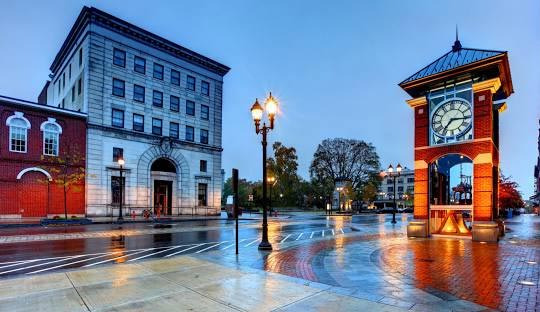
Concord is the capital of New Hampshire, a city that holds a deep history and rich cultural heritage. This city began as the land of early Native Americans, went through the colonial period, and today stands as a center for politics, education, and culture. Let's take a closer look at the history of Concord.
1. Early History: Native Americans and European Settlers
Native American Era
Concord was originally the land of the Abenaki tribe. This area, rich in rivers and forests, provided essential resources for survival to the Native Americans who lived by hunting and fishing. In particular, the Merrimack River was an important waterway for the local Native Americans.European Settler Settlement
In 1725, English settlers established a village in this area. The early settlers primarily engaged in agriculture and the timber industry. The area was incorporated under the name Rumford in 1733 and was later renamed Concord in 1765.
2. The Development of Concord and the Revolutionary War (18th Century)
Emergence as a Political Center
As the American Revolutionary War began in 1775, Concord became the political center of New Hampshire. With the establishment of the state legislature here, it was designated as the capital of New Hampshire, and subsequently, state government agencies concentrated in this location.Economic Growth
In the late 18th century, Concord experienced significant growth in the timber, agriculture, and textile industries. Particularly, the transportation along the Merrimack River became active, leading to economic prosperity.
3. The Industrial Revolution and the Railroad Era (19th Century)
Industrialization and Urbanization
In the early 19th century, Concord joined the wave of industrialization in the United States, achieving rapid economic growth. Wood processing, stone quarrying, and manufacturing became the main industries. Notably, Concord became known for its high-quality granite production, which was used in construction projects across the United States.Introduction of the Railroad
In 1842, the railroad was introduced to Concord, revolutionizing the city's transportation and logistics. This accelerated economic prosperity and made Concord a major transportation hub for New Hampshire and the New England region.Cultural Development
During this period, Concord also made significant advancements in education and the arts. Public facilities such as libraries, schools, and museums were established, and the education level of citizens improved.
4. The Emergence of Modern Concord (20th Century to Present)
Center of Politics and Administration
Concord remains the center of the New Hampshire state government, housing the state legislature and the governor's residence. It also receives national attention as the site of the New Hampshire Primary, the first primary election in the U.S. presidential election.Diversification of the Economy
In the late 20th century, Concord diversified its economy from a manufacturing base to include services, finance, healthcare, and education. Today, small businesses and non-profit organizations are actively operating.Revival of Culture and Arts
Concord has grown into a center for arts and culture in New Hampshire. Venues like the Capital Center for the Arts support local arts, and vibrant cultural activities take place through various festivals and events.
5. Major Historical Events
- 1775: Emergence as the political center of New Hampshire during the Revolutionary War.
- 1765: The city name changed from Rumford to Concord.
- 1842: Development into a center of industry and transportation with the introduction of the railroad.
- 1910s: The heyday of granite quarrying and the timber industry.
- 20th Century: Secured national political significance as the site of the presidential primary.
Today, Concord has grown into a city that not only serves as a political center but also boasts education, arts, and economic prosperity. It is home to various cultural and historical landmarks, playing a central role in the economy and society of New Hampshire.
Concord has evolved into a modern city while retaining its historical charm, offering a unique experience to both visitors and residents.





 U.S. Weather Bureau News |
 US Regional Information Blog |
 Living in America and Writing Essays |
 zen zeng |
 ovelion |
  DREAM BIG |
  frostbite |
  330 Forever My Love |
  El Dorado |
  dralix58 |
  Gorama Round |
  Skydiving |
  dreamport |
  Yellow Snowman |
  Toaster Pizza Magic Show |
  velvetnom |
  Anytime Journey |
  Mrs. Duluth |
  jaxter |
  Atlanta Mama |
  Baguette Blog |
  Tan Sol |
  US Embassy |
  Korean Mom |
  My NYC |