

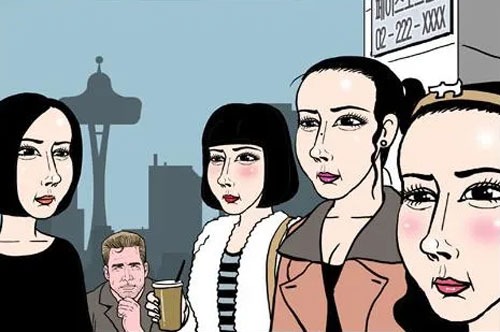
These days, every time I fly to Korea, especially when someone offers to set me up on a blind date, I feel a bit strange.
I am a healthy 34-year-old Korean man who came to the U.S. at eighteen and has lived in New York for 16 years. Having spent almost half my life in this city, at some point, I became more accustomed to New York than to Korea.
Perhaps that's why I feel uneasy whenever I have the chance to meet women in Korea. The current beauty landscape in Seoul comes as quite a shock to my eyes.
In the past, there was a term called "Gangnam plastic monster." It was used to mock people who had unnatural or awkward appearances due to excessive plastic surgery, but it is said to be rarely used now.
However, that word still lingers in my mind as a preconceived notion. Honestly, having lived in the U.S. and seen a variety of races and unique faces, the current beauty standards in Seoul are hard for me to accept.
Walking around Union Square or Soho in New York, you see a truly diverse range of faces. There are freckled faces, curly hair, people with broader noses, angular jaws, and even those with scars on their faces, which feel like part of their story. In this city, having a perfect face is not important; rather, it's about how confidently one accepts and lives with their own face that defines beauty.
But in Seoul, the atmosphere is completely different. From subway ads to the people walking down the street, similar faces seem to repeat as if they were all produced in the same factory. Overly elevated noses, excessively large eyes, artificially sculpted jawlines. It feels strange to see faces that used to be considered obvious signs of plastic surgery now being seen as symbols of well-maintained beauty.
The saddest part is the atmosphere that views differences as wrong.
Even a slight deviation from the norm causes anxiety, and people use celebrity faces as a template to modify their own. As a result, their unique aura or identity seems to fade away, leaving only similar shells behind. I remember Seoul having a much more diverse range of faces than it does now, but these days, it feels like appearances have become a prison that must be managed like a specification.
Of course, I don't want to say that plastic surgery is bad. It can be a choice for self-satisfaction. However, I hope people will ask themselves whether that satisfaction truly comes from within or is a result of societal pressure and the gaze of others. In a city where everyone tries to become the same doll, it's becoming increasingly difficult to find that person's unique aura and atmosphere.
My New York friends sometimes ask me,
"Why do all Korean women look so beautifully similar?"
I sense that there is more curiosity than admiration in that statement.
Now that I'm 34, one thing has become clear to me. True beauty is not in the trending face but in the unique texture of a person that does not fade over time. The artificial beauty created by plastic surgery has a short shelf life, but the gaze and expressions that come from someone who comfortably accepts themselves are not easily imitated.
Seoul has truly developed dazzlingly, but it's a pity that behind that glamour, natural individuality seems to be disappearing one by one.
I hope that the next time I go to Korea, I can see many people with distinct faces, and thus, more attractive real beauties.
 OliviaHotBar






 Khan Film Blog Production |
 dermoon |
 hoosierdaddy |
 sun walker |
 Let's Be Like a Salt-like City Person |
 Tomato Health Club blog |
 Open Flex Mind |

 Moo Tang Clan |
  Korean Mom |
  My NYC |
  moo moo |
  Mr Oh |
  forevergee |
  festival |
  manchester |
  constant |
  Leapfrog Move |
  vibranto |
  Tora Tora |
  yellowbutter |
  Dolly |
  US Embassy |
  NYC saladbar |
  Finding Superfoods |
  lightyear |
  song bang |
  vexomo |
  Indiana Jones |