
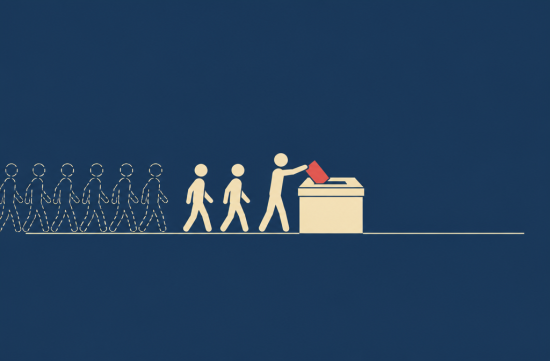
These days, there's a sign for early voting in front of the local library. However, the parking lot is surprisingly empty. Thinking back to the long lines during the presidential election, it makes you wonder if this is really the same country and the same election.
This year, November 3rd is the midterm election. All 435 seats in the House of Representatives and some in the Senate, as well as governors in several states including Maryland, will be elected. Early voting in Maryland starts on October 22 and ends on October 29.
However, many people feel that these elections receive less attention than presidential elections. Today, we will confirm that feeling with numbers and gradually unpack why this is the case.
First, let's look at the data. According to the Pew Research Center, the voter turnout for the 2014 midterm election was 34.4 percent. This means that only about one in three eligible voters cast their ballots.
In 2018, it jumped significantly to 48.1 percent. Pew described this figure as the highest midterm voter turnout seen in over a century.
In 2022, it slightly decreased to 45.1 percent. This was despite nearly 107 million valid votes being cast in the House elections.
In contrast, the voter turnout for presidential elections in both 2020 and 2024 was in the mid-60 percent range. Even the record-breaking 2018 midterm election turnout is still far below that of presidential elections.
What's more interesting is that this gap has not just appeared recently. According to Pew, the phenomenon of midterm voter turnout being lower than presidential elections has been consistent since the 1840s.
Interestingly, in the early days of the nation, the opposite was true. More people voted in midterm elections back then because the center of federal power was not the presidency but Congress.
This brings us to the first reason. People respond to where the power lies. Currently, U.S. politics revolves around the presidency, so if the president's name is not on the ballot, interest tends to wane.
Political scientists refer to this as surge and decline. During presidential elections, even those who are usually indifferent to politics are swept up in the atmosphere and go to the polls, but during midterms, they tend to drop off again.
In simpler terms, it's similar to the difference between the World Cup final and the regular season of the K-League. While the final attracts even those who don't usually watch soccer, only true fans remain in the stadium during the regular season.
The second reason is media and money. During presidential elections, there are months of TV debates and advertisements. Midterm elections are divided by districts, so the national excitement doesn't concentrate in one place.
The third reason is competition. According to Pew's analysis, in the 2022 House elections, 35 out of 435 seats, or 8 percent, had candidates from only one party. It's hard to justify taking the time to vote in an election where the outcome is obvious.
Conversely, states with high voter turnout that year had competitive gubernatorial or Senate races. Ultimately, what drives people to vote is the tension of a close race.
The fourth reason is age. One study found that voters aged 18 to 29 accounted for 17 percent of the total votes in presidential elections, but only 12.8 percent in midterms.
As younger voters drop off, the proportion of older voters increases. Therefore, the faces of those who vote in midterm elections are quite different from those in presidential elections.
Finally, there is the psychological tendency to check the ruling party. Economist Brian Knight's research suggests that among several factors, the tendency to express dissatisfaction with the president has the greatest impact. This is also linked to why the ruling party often loses seats in midterm elections.
Of course, the voting method can also have an impact. However, Pew stated in its 2022 analysis that it found no clear correlation between complicated voting procedures and voter turnout. This suggests that interest is a bigger variable than rules.
From all this, an irony emerges. The decisions that directly affect my life actually come more from midterm elections.
Governors, state legislatures, school boards, and county councils that influence property taxes and education budgets are all on this ballot. It's not the president but the House that actually controls the federal budget.
I personally have a strong interest in how the government spends tax money. Skipping the election to choose those who control the purse strings is honestly no different from handing over your household budget to someone else.
From the perspective of our Korean community, the calculation is simple. The lower the voter turnout, the more weight each vote carries. If only 45 out of 100 people vote, the voices of those who participate will be that much louder.
Politicians are not fools. They analyze data on which neighborhoods and groups consistently vote. It's a harsh reality that the complaints of those who vote are addressed first.
Therefore, I do not agree with the view that midterm elections are merely a preview of presidential elections. Rather, they are much closer to the main event that determines our local governance.
For those who are voting for the first time and feel burdened, I recommend checking your polling place and sample ballot on your state's election board website. Reading it in advance will significantly reduce the time spent wandering around at the polling place.
In Maryland, during the early voting period, you can vote at any early voting center within the county. On election day, November 3, you can vote at your designated polling place from 7 AM to 8 PM.
Patterns that have persisted for over 180 years are unlikely to change overnight. However, it's not difficult to be the one who breaks that pattern. Just dedicate 30 minutes this week.
 BananaSonata
 CocoHello

 Tan Zoo |

 hot chocolate |

 Chichiki Chicago Train |

 Noodle Noodle |

 Twist Kim |
 silvexo |

 mygoddess blog |
 ground |

 citrus pop |


 Annapolis NSA |
 ssome |
 skykong |
 Shining Our Own World |
 gardener 007 |
 golfmaster |
 Nanana Nanana Nanana |
 Who's watching? |
 endone |
 RockStar |
 Casa Mia |
 You Only Live Once |
 Hardworking CPA |
 Joyce 77 |
 Runner Kim |
 My Town My Way Blog |
 My Miami Stories |
 Entip |
 Tony Park |
 Jean Claude Bundang Blog |
 DJ DC BLOG |