
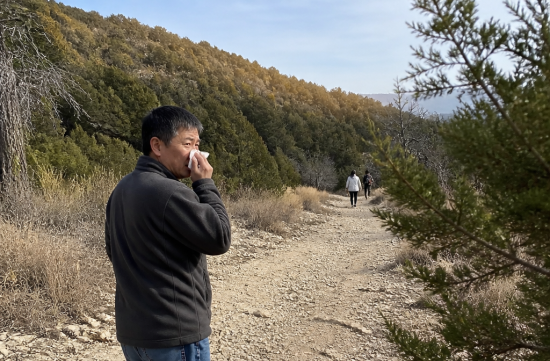
When Austinites start sneezing from the morning in winter, they generally know that the guest has arrived again this year. Although it's still mid-November and not in full swing yet, I've learned from experience that it's better to prepare early.
Because of the name cedar fever, I initially thought it was similar to the flu. However, it actually refers to an allergy to the pollen from the Ashe juniper, commonly known as mountain cedar. The name suggests fever, but in reality, it doesn't usually cause a high fever, which is a bit unfair.
According to data from Texas A&M, if your temperature exceeds 101.5 degrees Fahrenheit, it's likely not due to pollen. So if you do have a fever, it's better to suspect a cold or the flu rather than blaming the cedar.
So when does it start? According to the Texas A&M Forest Service, pollen typically begins to spread around mid-December and peaks in mid-January. It usually tapers off by early March, right before spring pollen from oak trees takes over.
It's like a relay race with hardly any breaks. Cedar in winter, oak in spring. The Austin allergy season is year-round.
There's a reason I mentioned the cold snap in the title. Junipers love to release their pollen right after a cold front passes.
When cold air moves in, the weather becomes dry, the winds pick up, and the pressure changes rapidly. Under these conditions, the pollen sacs open and release pollen into the air like smoke from a fire. It's so intense that it can be mistaken for wildfire smoke, which is enough to make anyone's nose itch just thinking about it.
Interestingly, only male trees release pollen. Female trees produce small cones that only receive pollen. However, there's no need to check if your backyard tree is a female; pollen travels for miles.
That's why Texas A&M does not recommend cutting down trees around your home. Just trimming a few trees in your yard won't solve the problem.
Regionally, the area west of I-35, particularly the Hill Country, is the worst. Austin sits right on that boundary, so living on the east side doesn't guarantee safety.
Will this year be severe? To be honest, I haven't found any official forecasts for the 2026-27 season as of mid-November. Last January, there were comments from experts suggesting a warm winter without hard freezes could lead to a longer season, but ultimately, it will depend on the weather.
Since predictions are uncertain, my conclusion is to prepare anyway. You buy an umbrella before it rains, not after, right?
The first tip is timing your medication. An allergy specialist in Texas recommends that those confirmed to have cedar allergies should start using nasal sprays at least 1-2 weeks before the season begins. If you wait until symptoms appear, you're always a step behind.
Some steroid nasal sprays are available over the counter at pharmacies. However, some types shouldn't be used continuously for more than a few days, which can be confusing.
So, it's essential to consult with a doctor or pharmacist about this. If you take regular medications or have asthma, it's even more crucial. Spending five minutes reading a label can make a significant difference for the entire season.
The second tip is indoor air quality. The CDC advises keeping windows closed during pollen season and using high-efficiency filters in your home's HVAC system.
There's a caveat: you should first check if your system can handle that filter and whether it will affect your warranty. Changing a filter only to incur air conditioning repair costs can be frustrating.
So, I recommend checking your filter size now and replacing it before the season starts. By December, when pollen is in the air, the shelves at the store are likely to be empty.
The third tip is to develop a habit after being outside. Following CDC recommendations, you should shower after going out to wash off any pollen on your skin and hair and change your clothes.
It's also advised not to rub your eyes outside and to wash your hands before touching your eyes indoors. It sounds obvious, but when your eyes are itchy, your hands instinctively go there.
The fourth tip is to keep an eye on pollen forecasts. The CDC also recommends checking forecasts and reducing outdoor activities on days with high pollen counts. Make it a habit to check the pollen levels along with the temperature when looking at your weather app.
Especially when a cold front is forecasted, it's wise to be on alert the next day. If you usually dry your laundry outside, it's better to use the dryer that day.
The fifth tip is to differentiate symptoms. If your main symptoms are a runny nose, sneezing, and itchy eyes, it's likely cedar. However, if you develop a high fever or severe body aches, that's a different story.
During winters like this, flu and COVID-19 can also be circulating, so relying on self-diagnosis can be risky. If you're unsure, it's best to check with a doctor.
Personally, I recommend finishing the timing of your medication and changing your filter before December. The other tips can wait until the season starts, but these two need to be done in advance for them to be effective.
Austin is a great city with nice weather, but for a few weeks in winter, it feels like your nose is paying rent. However, with some preparation, you can reduce that burden.
Before the first cold front forecast comes out, check your filter size this weekend. Buying an extra box of tissues wouldn't hurt either.
 SunJourney
 CEOChoi




 fruitflash |

 Anjollinya Blog |

 United States Army |

 premium |

 The Emperor Must Grow |

 Living with a Consistent Heart |

 U.S. Weather Bureau News |

 Dallas Fort Worth DFW |

 lumix88 |

 Korea Forever |
 action blog 101 |
 athome blog |
 calvor |
 Haha and Bomi Blog |
 Lee Ton |
 viba viba |
 Olivia's Blog |
 208 Master |
 crumb |
 blanke |
 Burbank Lee |
 tervox95 |
 silverado |
 Grow Your Gut Bacteria Well |
 Kim You Shin |
 Squid Q |
 gelatonew |
 river9 |
 ttano |
 Eagle in America for Five Years |