
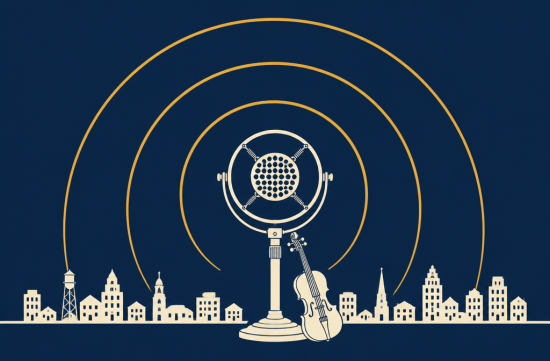
Every year at the end of November, the local radio stations frequently mention the word "birthday." It's not about a person's birthday, but the birthday of a show.
On the night of November 28, 1925, WSM Barn Dance, the predecessor of the Grand Ole Opry, first hit the airwaves. The Opry still celebrates this date as its official birthday.
Last year marked its 100th anniversary, and this year is its 101st birthday. In numerical terms, it has surpassed a century, yet it feels remarkably current when you listen to it.
Surprisingly, it all started with an insurance company. The National Life and Accident Insurance Company opened the radio station WSM on October 5, 1925.
The call sign WSM was derived from the company's slogan "We Shield Millions." The insurance ad phrase about protecting countless people ultimately became the label for the music city.
About a month after the station was established, on November 2, 1925, WSM brought in announcer George D. Hay. He had previously hosted a program called National Barn Dance at Chicago's WLS.
The first performer Hay introduced was an elderly fiddler named Uncle Jimmy Thompson. The venue was the studio on the fifth floor of the insurance company's building.
Thompson's exact age varies across sources. The official history of the Opry, the Tennessee Encyclopedia, and old promotional materials list different numbers, so I just remember him as "a rather elderly fiddler."
However, this show was not originally called the Opry. The name change occurred in 1927, and the reason is quite fitting for this city.
At that time, WSM aired Hay's show right after Walter Damrosch's classical music program, which was broadcast by NBC. The structure featured opera and classical music in the earlier hour, followed by country fiddles and banjos.
Hay reportedly responded by saying that since listeners had just heard grand opera for the past hour, he would now present the Grand Ole Opry. It was a playful jab at highbrow music.
Little did he know that this one joke would lead to a name that would last a century. This part is my favorite. It captures a Southern ease that neither belittles the formal side nor feels intimidated.
Since then, the show has moved several times. In June 1943, it moved to the Ryman Auditorium downtown, where it remained until 1974.
Since 1974, it has been broadcasting from the Grand Ole Opry House built east of downtown. Nevertheless, the Ryman is still referred to as the "Mother Church of Country Music" to this day.
So when did the nickname "Music City" come about? Many people get confused here; it didn't originate on the day of the first broadcast in 1925.
Various sources attribute this nickname to WSM announcer David Cobb in 1950. He referred to Nashville as "Music City U.S.A." during a broadcast.
The specific program where this phrase originated varies across sources. Some say it was during an NBC radio program hosted by Red Foley, while others claim it was during an Opry broadcast.
Since no recording exists, it seems best to accept it as "traditionally said." However, the fact remains that it came from the same station's microphone.
Interestingly, it's interpreted that Cobb wasn't solely thinking of country music when he said this. By that time, the city's music scene was already much broader than just country.
There's another legend regarding the origin of the nickname. It's said that in 1873, Queen Victoria of England called this city the music city after hearing the Fisk Jubilee Singers perform.
However, even the director of the Fisk Jubilee Singers has stated that he does not believe this story, and local public radio has concluded that it is difficult to prove. While it's romantic, I would lean towards the recorded history here.
To summarize, a single radio show did not directly create the nickname.
Instead, that show attracted performers and listeners to this city for 25 years, and the nickname naturally emerged from that. It's like how a beach gets its name only after the tide comes in.
The Opry is considered the longest-running radio broadcast in America. The fact that songs have been flowing from the same frequency for over a hundred years is truly remarkable.
I sometimes miss the sound of waves in this landlocked city. Yet, when I tune into AM 650 on Saturday nights, that emptiness strangely feels a bit less.
Amid the crackling noise, the sound of fiddles rises and falls like swells from the distant sea. That wave, which started on the fifth floor of an insurance company a century ago, has yet to fade.
If you have time this weekend, I recommend tuning in to the radio or streaming it, even if you can't get tickets to a show. It's the easiest way to hear where the name "Music City" came from.
 Fruity Pebble
 BreakingBad


 Tan Zoo |

 hot chocolate |
 Chichiki Chicago Train |
 Noodle Noodle |

 Twist Kim |
 northpeak |
 U.S. Weather Bureau News |

 swiftlane |
 ssome |
 skykong |
 Shining Our Own World |
 gardener 007 |
 golfmaster |
 Nanana Nanana Nanana |
 Who's watching? |
 endone |
 RockStar |
 Casa Mia |
 You Only Live Once |
 Hardworking CPA |
 Joyce 77 |
 Runner Kim |
 My Town My Way Blog |
 My Miami Stories |
 Entip |
 Tony Park |
 Jean Claude Bundang Blog |
 DJ DC BLOG |