

In the past, when I heard that robots would replace human jobs in factories, I thought, "That's still a long way off."
But now, it's already a reality. Especially in the logistics industry, humanoid robots are starting to take over tasks that were once done by humans.
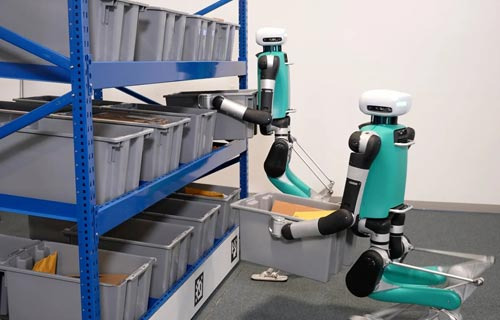
Recently, a video released by the American robotics company Figure AI is truly astonishing. Four humanoid robots sorted an incredible 250,000 packages over 200 hours.
They pick up boxes like humans, turning them so the barcode faces down, and move them to the side conveyor belt.
If packages get tangled, they bend down to retrieve them and reach out to place them on the workbench.
Just a few years ago, I would have thought, "How can robots do that?" but now they mimic human movements almost perfectly.
Amazon has also been moving in this direction for quite some time.
Since 2023, they have been deploying the humanoid robot 'Digit' in actual warehouses to clear empty boxes and move items.
They are also operating tactile robots that do not damage items and robots that can work simultaneously with multiple arms.
What's even more surprising is their future plans. Amazon expects that by 2033, sales will nearly double compared to now.
Normally, they would need to hire over 600,000 new employees, but the company believes that due to robotic automation, they will hardly need any additional staff.
From the company's perspective, productivity increases and costs decrease, so there's no reason to avoid introducing robots. But what will happen to the people?This is where the concern begins.
Companies explain that they are "entrusting repetitive and dangerous tasks to robots."
In reality, carrying heavy boxes all day in a logistics center is hard labor that puts a significant strain on the back and knees. The risk of accidents is also considerable.
It may make sense for robots to take over such tasks.
However, the reality is not that simple.
Where will the people who used to do those jobs go?
Companies say that they can transition to new technical jobs.
They also mention the need for people to manage and maintain the robots.
Of course, that's true.
But a 50-year-old employee who has worked in a logistics center for 20 years cannot suddenly become a robot engineer.
Telling workers in their 40s and 50s to "study AI" or "learn programming" is far from reality.
In the past, machines replaced human arms, but now AI is starting to replace human eyes and judgment as well.
Humanoid robots can distinguish items, identify locations, and change their actions based on the situation.
The pace of technological advancement is too fast.
It doesn't seem like it will stop at logistics centers.
China's JD.com has stated that robots will even take over the last mile of delivery.
The company predicts, "A day will come when delivery drivers will no longer be needed."
If this becomes a reality, many jobs such as delivery drivers, warehouse workers, and shipping personnel could be affected.
Of course, new jobs will also emerge.
Jobs like AI developers, robot technicians, and automation system operators are likely to increase.
However, if the rate at which existing jobs disappear is faster than the rate at which new jobs are created, society could face a significant shock.
Therefore, we must not only discuss the technology of "robots replacing human jobs" but also consider how to help displaced individuals find work again.
We need to discuss how to provide retraining, what jobs middle-aged and older workers can take on, and what safety nets the government and companies should prepare.
Technology does not stop.
Humanoid robots will become even smarter in the future.
Automation is also an unstoppable trend.
But what truly matters is not how many tasks robots can perform.
It's about how we can create a society where people can coexist amidst these changes.
The era of AI and robots has already begun.
Now, what we need to prepare for may not be the technology to create robots, but rather how to protect people in the midst of these changes.
 OkElectronic
 KoreaNews
 GochujangSpy







 coloradoman |
 pintos |
 mapsina |
 Mr. Largo |
 Victory 1988 |
 newyorker 101 |
 International Court |
 Things to Do to Buy a House |
 Living with a Consistent Heart |
 NYC saladbar |
  sweetvan |
  Augusta Univ |
  Round and Round Children's Song Kingdom |
  butter 90 |
  Lando Mao |
  Washington Denzel DJ |
  LIZ Legal Information Blog |
  vegas mom |
  Sandiego Auntie |
  Premium Gas Camp |
  Things to know |
  TEXAS Fishing Boat |
  AUTO OK |
  aaoaa |
  Florida King |
  Encyclopedia of New York and Surrounding Areas |
  Study Abroad Life Know-How Tips |
  Conflite Teacher |
  Silent Sea |
  Montgomery Mom |