
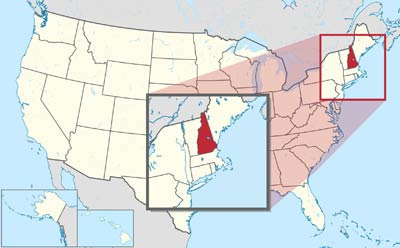
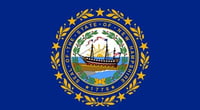
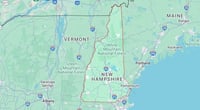
In 1623, this area started as an English colony, initially centered around agriculture and forestry. However, in 1679, it was designated as a 'Royal Province of New Hampshire' under the direct rule of the English crown, increasing its political influence. As the 18th century approached, New Hampshire was at the heart of the independence movement that spread across colonial America.
In 1775, as the American Revolutionary War intensified, New Hampshire was one of the first states to declare independence from England, and in 1776, it was one of the 13 states that signed the Declaration of Independence. Furthermore, in 1788, it was one of the first states to ratify the U.S. Constitution, playing a 'leading role' in the founding process of the United States.
As the mid-19th century approached, New Hampshire rapidly grew with the winds of industrialization. The textile industry, machinery manufacturing, and paper industry thrived, contributing to the New England industrial region, and in the 20th century, it expanded into manufacturing sectors like automotive parts and electronics.
However, as time passed, agriculture declined, and the service and tourism industries grew, establishing the current economic structure. Today, New Hampshire is also famous as a 'no tax state.'
With no state income tax or sales tax, both businesses and residents face less economic burden. This makes it popular among retirees, self-employed individuals, and those moving from other states. Additionally, over 80% of the state is covered in forests and mountains, and thanks to its clear lakes and green valleys, it is loved as a year-round tourist destination.
As of 2020, the population is about 1.4 million, making it one of the states with a relatively small population in the U.S. It has a higher proportion of rural areas than urban ones, and the population density is relatively low. Major cities include Manchester (about 110,000), Nashua (about 90,000), and the state capital Concord (about 40,000), which play central roles.
The racial composition is predominantly white at about 93%, with Hispanics or Latinos at about 4%, and African Americans and Asians each at around 2%. Although diversity is lower compared to other states, some changes have been occurring in recent years.
Economically, New Hampshire is quite solid. As of 2020, the median household income is about $77,000, which is higher than the national average. Thanks to low taxes, real income remains high, and the cost of living is relatively low.
The main industries are manufacturing and technology, along with agriculture and services, particularly in high-tech and precision manufacturing, where stable jobs are plentiful. Tourism cannot be overlooked either. In winter, it is vibrant with ski resorts and snow-covered mountain tourism, while in summer, it offers boating, hiking, and camping, making it a lively state year-round.
Ultimately, New Hampshire was once a state that ignited the flame of independence, and it has transformed into a state that attracts people with its stable economy and abundant nature, free from tax burdens.






 U.S. Weather Bureau News |
 Living in America and Writing Essays |
 zen zeng |
 ovelion |
  New Kids Young |
  road98 |
  Churros Train Conductor |
  gleeful |
  Burbank Lee |
  Olivia's Blog |
  Bushing Around Life |
  Active |
  Cherokee Rose |
  Kor. Master |
  Holey Moley |
  Conflite Teacher |
  Hodong Prince Over Flex |
  Mist inn |
  citrus pop |
  Onion Ring |
  phoenixia |
  viewtop |
  loverun |
  Kim Do Sun |
  SEVEN SEVEN |