

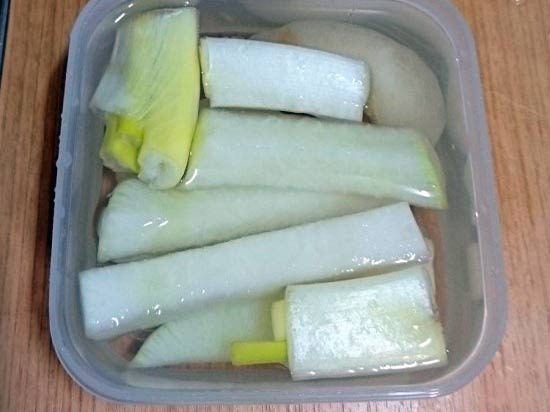
Dongchimi is made with radish and salt. The ingredients are simple, yet many people fail at making it.
"Isn't it just putting in radish, adding water, and salt?" you might think, but when you actually try it, you can end up with a fishy smell, it being too salty, or in severe cases, the broth becoming slimy as if it has gone bad.
However, the reasons for these failures are similar. It's about temperature control, salt ratio, and the condition of the radish.
As my grandmother used to say, dongchimi is a very delicate dish despite its appearance.
When I make dongchimi, I first wash the radish, whole garlic, pear, and green onion very thoroughly.
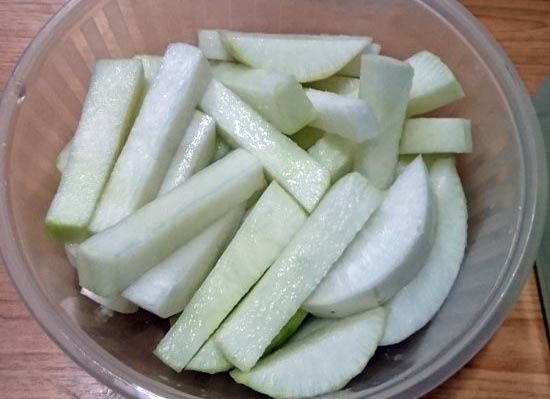
The radish should be cut into pieces about 1 cm thick and 5 cm long for good eating and stable broth flavor.
Put the cut radish into a large bowl or container and mix in about 1 part salt and 1 part sugar.
The reason for adding a little sugar is not just for sweetness, but also to help draw out moisture from the radish quickly and aid in fermentation.
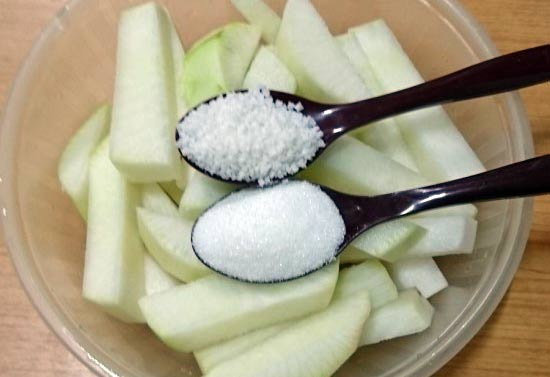
Usually, it should be salted for about 30 minutes to 1 hour. If salted for too long, the radish will lose its crunchiness.
There's also a tip to reduce dishwashing. I just salt it directly in the container I plan to store it in later. It's more convenient not to use an intermediate bowl.
Next, add salt to water and bring it to a boil. This step is important!
You can dissolve the salt in plain water, but boiling and cooling the water reduces the possibility of bacteria, making the broth more stable.
Let it cool to a "lukewarm" temperature, not completely cold.
Prepare the sliced garlic and green onion. Slice the garlic thinly, and cut the green onion to a similar size as the radish.
If you have ginger, you can add a little, and if you have chives, rolling them up and adding them makes it look nice.
Add the prepared ingredients to the salted radish and pour in the cooled saltwater. The important thing here is that the water should not be hot.
If you pour in hot water, the radish will cook, resulting in an odd texture. One of the most common reasons for dongchimi failure is not adding enough salt.
Many people start off thinking about health and make it too bland, which can lead to strange fermentation and a fishy smell.
At first, it should taste a bit salty. Later, as the radish releases more water, the flavor will weaken.
Cover it and let it sit at room temperature for about half a day to a day for the flavor to develop.
However, this is where many people fail again. Since this is a winter dish, the high indoor temperatures these days can cause fermentation to progress too quickly.
So, if you leave it at room temperature for more than a day, it can suddenly turn sour and develop a fishy smell. This happens even faster in the summer.
Once you taste the broth and it has a slightly fermented flavor, it's safe to put it in the refrigerator.
If the broth tastes bland, you can add a little more salt, and if it's too salty, you can add water.
It's much easier to adjust at the end than to try to get it perfect from the start.
Ultimately, making dongchimi is a battle of "cleanliness" and "temperature." Those two factors are more important than the ingredients.
If the radish is in poor condition or not cleaned properly, the smell will come up quickly, and if the temperature is too high during cooking, the fermentation will be excessive, ruining the flavor, so keep that in mind.
 ChiliBeam
 CandyTank







 Texas Real Estate Blog |
 Seattle - Emerald City |
 Yahoo LALA |
 Ishiyoung Forever 208 |
 Yellow Snowman |
 Always Atlanta |
 SPACE SHIP |
 Bearded Strawberry Smoothie |
 Let's Be Like a Salt-like City Person |
 Young Kim and Cheol's Blog |
  torvik |
  charger |
  holy cheese |
  Pleasant K |
  Rolling Joy Life |
  lidus |
  French Macarons |
  Central Intelligence Agency Deputy Director |
  ATL Power 1 |
  MP Forever |
  Soy Angelino |
  San Jose Pop |
  Pronunciation Yo |
  hamooo |
  Entip |
  Yavrix 92 |
  cherry cherry |
  Coastal city |
  There Are Such Things in the World |
  Mazinger Z Rocket Punch |