

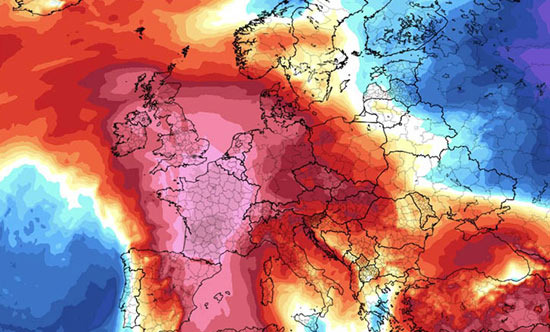
Recently, in London, England, the maximum daytime temperature exceeded 33.5°C, breaking the record for May.
Considering that the previous record was 32.8°C in 1922, this can be seen as a sign that climate patterns are changing.
The problem is not just the high daytime temperatures. Nighttime temperatures are also staying above 20°C, disrupting sleep.
In Europe, many areas have a low rate of air conditioning, making this heat feel even more intense.
Particularly in the UK, it is rare for temperatures to exceed 35°C even in summer. The fact that we are already approaching that level in May is very unusual. The UK Health Security Agency has issued a heatwave warning unusually early in May.
Orange alerts have been issued for major areas such as London and eastern England, while yellow alerts continue in other regions. This indicates that the heat is not just uncomfortable but poses a direct health risk.
This heat is not limited to the UK. France is also facing serious conditions. In Paris, temperatures have risen above 30°C for the first time this year, reaching 31.9°C, and several regions have broken their May temperature records. Notably, there have even been fatalities during outdoor sports activities, highlighting the dangers of the heat.
One reason for these impacts is a lack of adaptation. May is still a time when the body is not accustomed to the heat.
Across Europe, regions like Spain, Portugal, and southern France are already forecasted to see temperatures between 35°C and 37°C. In Brittany, a heatwave warning has been issued for the first time in May, marking a significant event since the introduction of the related system.
According to meteorological analyses, this heat is expected to persist for nearly a week at temperatures up to 12°C higher than usual. This is not just a warm spring; it feels as if the season itself has been advanced. The boundary between spring and summer is becoming increasingly blurred.
Ultimately, this heatwave is not just a weather news item. It is changing in a way that summer is not only getting hotter but also starting earlier and lasting longer.
Recently, many people have been asking, "Is this due to El Niño?"
To conclude, there is some influence, but it is not sufficient to explain everything. El Niño is a phenomenon that affects global climate by raising sea surface temperatures in the equatorial Pacific, generally contributing to an increase in the Earth's average temperature. Therefore, when El Niño occurs, there is a higher likelihood of hotter and more extreme weather.
However, this European heatwave cannot be explained solely by El Niño. It is more accurate to view it as a result of a combination of high-pressure stagnation in Europe, changes in atmospheric circulation, and already elevated global average temperatures. Particularly, the cumulative warming over recent years has raised baseline temperatures, and when combined with El Niño, it has led to more extreme outcomes.
In the end, while El Niño can act as a "spark," the occurrence of record-breaking heatwaves starting in May should be viewed in the context of long-term climate change. It is not just a temporary phenomenon but rather a situation that is likely to repeat more frequently.
 PuddingVibe
 JapchaeRadar







 GOGO SING |
 Hajiwon Blog Hair Salon |
 tartbear |
 novapixel |
 NEXT ROUND |
 Learn English Accurately |
 Sandiego Auntie |
 Tainami American Travel Story |
 Korea News Economic News |
 Mau Nui |
  fixed |
  AL ALASKA |
  amola |
  History Repeats Itself |
  Doori Ark |
  Rainbow Bridge to the Sky |
  Sunny Fullerton |
  U.S. Weather Bureau News |
  Gold Bar |
  Banana Style Life |
  Tesla X |
  Old English |
  urbanmint |
  forestcloud |
  forever young |
  Arlington house |
  liquid asset |