

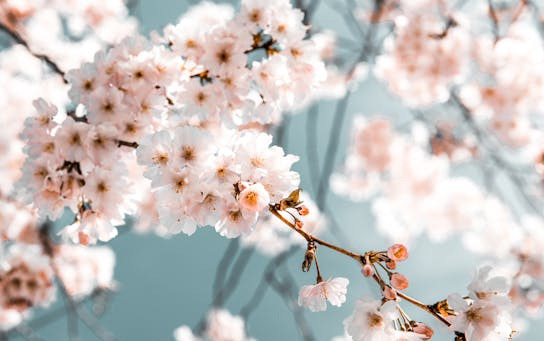
You might wonder, "Why are there so many Japanese cherry blossoms in the U.S. capital?" The answer dates back to 1912.
At that time, Yukio Ozaki, the mayor of Tokyo, donated about 3,000 cherry trees to the United States to commemorate the friendship between Japan and America. Japan wanted to promote its culture to the world, and the U.S. was also interested in expanding international exchanges.
Cherry blossoms were considered one of Japan's symbols, making them the perfect gift to express the friendship between the two countries.
In fact, the first donation was not successful. Due to pest issues, the initial trees had to be discarded. Later, Japan sent healthy saplings, marking the true beginning of the cherry blossom history in Washington D.C. Many of the trees today are known to be descendants of those original donations.
The most famous location for cherry blossoms is Tidal Basin. This area is adjacent to major memorials such as the Jefferson Memorial, Martin Luther King Jr. Memorial, and Franklin Delano Roosevelt Memorial. In spring, the pale pink flowers bloom over the water, creating a picturesque scene. It's a blend of America's historical architecture and the symbol of traditional Japanese culture in one space.
Currently, most of the cherry blossoms in Washington D.C. are the Yoshino cherry variety, which is representative of Japan. The petals are a pale pink that is almost white, and when fully bloomed, they appear so vibrant that they look like clouds. Some areas also feature ornamental varieties that bloom in deep pink, allowing for a variety of colors to enjoy.
As cherry blossoms have become a symbol of Washington D.C., the National Cherry Blossom Festival is held every spring. This festival is not just a flower viewing event; it has evolved into an international cultural event celebrating the friendship between the U.S. and Japan, featuring parades, traditional performances, art exhibitions, and food festivals that last for weeks. Millions of tourists visit each year, significantly impacting the local economy.
Interestingly, despite the fact that the U.S. and Japan were adversaries during World War II, most of the cherry trees in Washington were preserved. There was a recognition to keep cultural symbols even amidst the massive conflict, and after the war, they took on even greater meaning as symbols of reconciliation and cooperation.
Today, the cherry blossoms in Washington D.C. are not just beautiful trees. They represent the landscape of the U.S. capital and a symbol of international friendship that has lasted over a century. Each spring, the cherry blossoms along the Potomac River paint the area pink, serving as a living history created by culture and diplomacy.
Thus, the cherry blossoms in Washington D.C. remain special to Americans and are a must-see spring highlight for tourists from around the world.






 candytip |
 Gold Bar |
 Pirate Ship Popcorn Maker |
 Montgomery Mom |
 Anjollinya Blog |
 El Dorado |
 Eldorado 88 |

 Washington Denzel DJ |
  Tonky |
  viroma |
  cookie |
  Live and that's it |
  Alright Twain |
  eatontown blog |
  HAWAII Korean Church News |
  Amore |
  linex |
  Balancework |
  laro90 |
  MEDBIO American Doctor Blog |
  SWAT TEAM BLK |
  DREAM BIG |
  frostbite |
  330 Forever My Love |
  dralix58 |
  Gorama Round |
  Skydiving |