
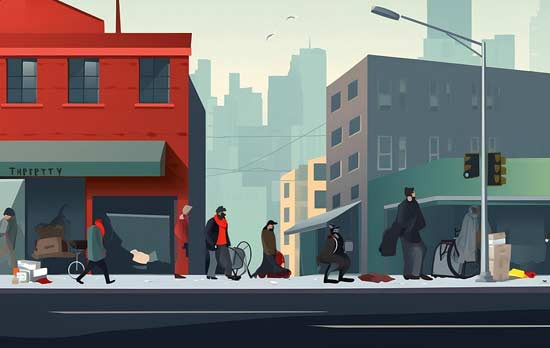
I'm a man in my 40s living in Burbank. For the past few months, I've been seeing homeless people more frequently in the alley in front of my house or downtown. At first, I thought, "How sad..." but these days, I often wonder, "Why are there so many now?"
There's a common discussion among people. They say that since the presidency of Ronald Reagan, the number of homeless people has started to surge. So, there are statements like, "Reagan changed the laws, and that's why we have homeless people."
But in reality, this issue isn't simply due to "Reagan alone"; it's a problem that has arisen from various historical changes overlapping.
In the 1980s, the U.S. federal government drastically cut funding for public housing for low-income individuals and housing assistance programs (Section 8). As a result, the availability of affordable housing decreased, which became one of the factors leading to the housing crisis and the increase in homelessness.
Additionally, the Reagan administration reduced budgets and policies related to mental hospitals and mental health systems. In simple terms, it allowed people who would have been confined in hospitals in the past to return to the streets. This was the aftermath of the so-called 'deinstitutionalization' policy.
So, the combination of "Reagan closing mental hospitals + withdrawal of public housing support + skyrocketing rents" all hit at once, leading to the chronic homelessness problem in major U.S. cities, including LA.
This issue existed even before the 1980s. The problem of homelessness in the U.S. has been present since the late 19th century as industrialization and urbanization progressed. NCBI+1 So, it's not just the 1980s; it's the result of structural changes that have accumulated over decades.
Reports indicate that there are tens of thousands of homeless individuals living in LA County. Among those many people, some are experiencing homelessness for the first time, while others have been pushed to the streets due to mental illness, substance issues, unemployment, or rising rent costs.Especially in areas like Burbank, when I see people setting up tents under the freeway or in adjacent areas, I wonder, "How did it come to this?" The high cost of housing, lack of affordable housing, inadequate social welfare systems, and insufficient mental health services all contribute to this situation.
So, attributing everything solely to "Reagan" may be an exaggeration. Of course, the policy changes during the Reagan era played a triggering role, but the housing market, local economy, social structure, welfare budgets, and mental health systems over the following decades have intertwined to create today's homelessness problem.
In simple terms, while Reagan may have been the one to open the floodgates, it was society as a whole that ignited and maintained the fire afterward.
Having lived in Burbank, I've become accustomed to seeing homeless people, but the more I see them, the more my heart aches.
On cold days, they sleep on the ground with just a tent, and in the summer, they spend the day on hot concrete.
People's gazes can be indifferent or even wary at times.
"Those who have come this far were once someone's mother or father, and they might have dreamed of a life like ours."
We are just lucky to have homes, cars, and jobs.
That luck just hasn't come to others.
Even if there may not be a big solution right now,
if we can't even show small interest, small solidarity, or small respect...
ultimately, the neighborhoods where people live will crumble.
We shouldn't just blame Reagan and end it there,
but rather accept it as a problem of the city we live in, our community.
We must not forget that some people are without homes, and some are waiting for help.






 garlic bread |
 Yo Lock Me Up |
 California Information News |

 My Town My Way Blog |
  Tora Tora |
  yellowbutter |
  Dolly |
  US Embassy |
  NYC saladbar |
  Finding Superfoods |
  lightyear |
  song bang |
  vexomo |
  Indiana Jones |
  meloncat |
  novapixel |
  mortrix |
  Esther 1983 |
  fortbliss |
  Moscow Kim |
  My Two Way |
  toastyfox |
  FLORIDA Acus |
  tracker |