

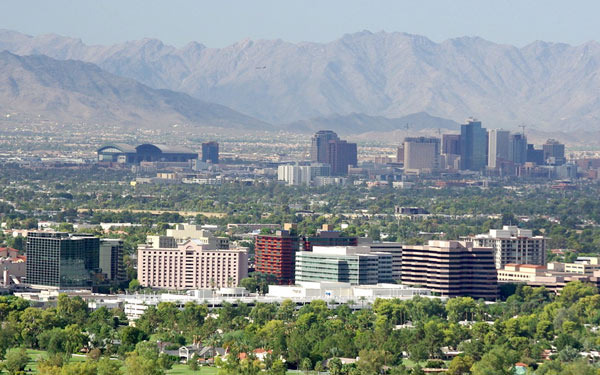
Looking at Arizona's economy, it was once a place that made some money from copper mining, then survived by running ranches and growing oranges, saying "the desert can sustain life." Nowadays, it suddenly presents itself as a future city with a focus on semiconductors and high-tech industries. While it seems to have undergone a perfect transformation on the surface, a closer look reveals that it is still balancing between the fate of the desert and reality.
To talk about the past, the symbol of Arizona's economy was the "5C": Copper, Cattle, Cotton, Citrus, and Climate. The idea that the desert weather was an advantage was quite unique, but it is true that tourism and agriculture were the main sources of livelihood.
However, now this 5C is becoming almost a museum artifact. As the population shifts towards semiconductor factories, advanced manufacturing, and technology industries, the past industries have lost their dominance. One could say that it is transforming from an agricultural state in the western desert of the U.S. to a 'future-oriented manufacturing state.'
The problem is that Arizona is absorbing this change too quickly. Semiconductor factories use an enormous amount of water, and not worrying about water in the desert is almost delusional. Water scarcity is already a reality, yet the state is pouring resources to attract a high-wage factory. Of course, the employment effects and economic ripple effects brought by high-tech industries are significant, but if the population grows steadily, issues like water, electricity, and housing costs will also increase. Simply saying, "We have high-tech industries, so we win!" overlooks the many risks involved.
Moreover, the real estate market has already lost control. Major cities like Phoenix are among the fastest-growing areas in the U.S. in terms of housing prices. While wages have not risen significantly, housing prices are skyrocketing, leaving residents confused about whether attracting semiconductor factories is beneficial or just a feast for outsiders. While growth seems positive, the reality is that those living there are finding it increasingly difficult to make ends meet, creating a paradoxical economy.
Tax policies also play a role. To attract businesses, taxes are cut, education vouchers are expanded, and welfare structures are reduced, leading to budget shortfalls. While the current situation appears vibrant due to business attraction, a financial deficit bomb could explode in a few years. Although the economic scale may have increased, how healthy it is remains another question.
Of course, Arizona's changes are not wrong. The diversification of the economy with a mix of tourism, high-tech, manufacturing, and logistics is undoubtedly a clear advantage. However, the image this state presents seems like a "desert eager to get rich quickly." With infrastructure still lacking, it is acting like a developed economy by prioritizing future industries, which is understandably unsettling.
Ultimately, the characteristic of Arizona's economy is not simply that it is a "growing state." It is a desert dreaming of rapid growth under the hot sun, but it feels like it is speeding without a solid foundation.
If water, housing, and financial issues are not properly addressed, it could shake like a sandstorm in an instant. While it may look glamorous now, the true value of this growth depends on how solidly the foundations are laid.
In the end, I believe Arizona is best described as a 'well-made-up desert economy' where opportunities and risks coexist.







 ultron78 |
 garlic bread |
 Sugar Cream Door Bulletproof Noodles |
 urbanmint |
 |
| 
 Kitchen Ideas |
 Toaster Pizza Magic Show |


 The Long Shot |
  Korean Mom |
  My NYC |
  moo moo |
  Mr Oh |
  forevergee |
  festival |
  manchester |
  constant |
  Leapfrog Move |
  vibranto |
  Tora Tora |
  yellowbutter |
  Dolly |
  US Embassy |
  NYC saladbar |
  Finding Superfoods |
  lightyear |
  song bang |
  vexomo |
  Indiana Jones |