

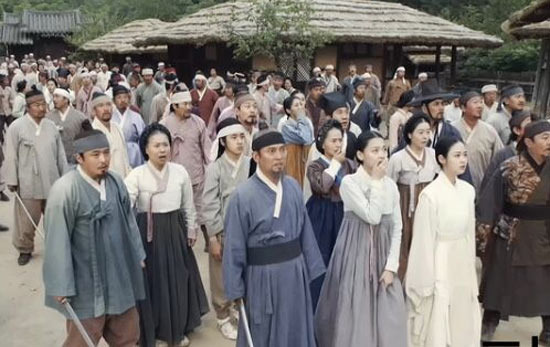
How much better off are we compared to 200 years ago during the Joseon Dynasty?
Out of curiosity, I looked it up online, and it seems that in terms of purchasing power, it has increased by about 150 times.
However, if we simply look at it in terms of "rice prices," we might miss the bigger picture.
The real difference lies not in prices but in the standard of living and the range of services available for consumption.
Currently, the purchasing power of the middle class is estimated to be hundreds of times greater compared to people 200 years ago.
First, let's look at the standards from the late Joseon period 200 years ago. At that time, the largest portion of consumption for ordinary farmers or commoners was almost entirely food.
Records show that 60-80% of a household's income was spent on rice or grains.
Clothing was purchased once every few years, medical care was essentially at the level of folk remedies, transportation was on foot, and there was almost no access to information or entertainment. In other words, most of the income went solely to "survival."
When looking at rice prices, there is an interesting point. A bag of rice (about 80kg) in the late Joseon period was roughly equivalent to a month's wage for a laborer.
If we consider the current average monthly salary to be around 3 million won, it means that purchasing power for rice has improved by about 10 times.
However, if we stop the comparison here, we will greatly underestimate the reality. The real gap lies in services and technology.
Starting with transportation, it took 15-20 days to travel from Seoul to Busan 200 years ago. The cost was also a significant burden for commoners.
Now, it costs about 60,000 won on the KTX. When factoring in the value of time, the efficiency of travel is not just dozens of times better, but essentially over 100 times more efficient.
Medical care is at a level that cannot even be compared. Back then, even a mild case of gastroenteritis could be fatal, and the average lifespan was around 30-40 years.
Today, antibiotics, surgeries, and health check-ups are commonplace. The accessibility of medical care is not just dozens of times better; the survival rates are from an entirely different era.
Entertainment is even more extreme. Commoners in the Joseon era had entertainment only during market days, traditional dance performances, and holidays.
Now, for just a few tens of thousands of won a month, we can enjoy unlimited access to Netflix, YouTube, music, games, movies, and sports. In terms of access to information and entertainment, our purchasing power is hundreds of times greater.
Housing also shows significant differences. At that time, commoners lived in thatched houses, had limited heating, and lacked facilities like flush toilets.
Today, electricity, running water, heating, refrigerators, air conditioning, washing machines, and the internet are standard. This is not just a simple price comparison; the quality of life itself is at a different level.
In summary, we can see it this way:
Purchasing power for food: about 10 times
Discretionary income relative to essential living expenses: about 20-30 times
Perceived purchasing power including services (medical, transportation, information, entertainment): at least over 100 times
Including convenience and choices in life: hundreds of times
The purchasing power of the current middle class is considered to be tens of times greater in monetary terms, at least over 100 times in terms of living standards, and fundamentally a different level of civilization compared to 200 years ago.
However, even though we live in a much more comfortable era than people in the past, many people still feel like they are struggling to get by.
The times have improved, but perhaps due to social media, the actual experience feels completely different, which is quite disheartening.







 novapixel |
 Peter Pan Pet |
 horse |
 Sunset Oregon |
 daisypat |
 garlic bread |
 Yo Lock Me Up |
 California Information News |

 My Town My Way Blog |
  manchester |
  constant |
  Leapfrog Move |
  vibranto |
  Tora Tora |
  yellowbutter |
  Dolly |
  US Embassy |
  NYC saladbar |
  Finding Superfoods |
  lightyear |
  song bang |
  vexomo |
  Indiana Jones |
  meloncat |
  mortrix |
  Esther 1983 |
  fortbliss |
  Moscow Kim |