

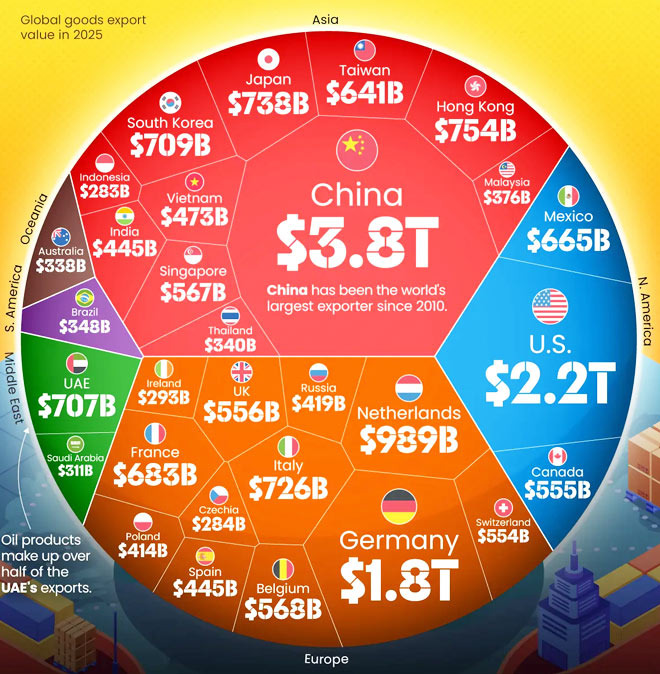
Looking at the numbers in the international export scale infographic, you can feel the character, history, and current position of each country.
The first thing that catches the eye is China. $3.8 trillion. This is simply not enough to express it as "a lot."
Even neighboring countries that export significantly appear small in comparison. China seems unlikely to give up its title as "the world's factory" for the foreseeable future.
Moving beyond just producing cheaply, there is now a trend to combine quantity with quality by incorporating technology.
Next to it, the United States shows $2.2 trillion? It's not a small number, but next to China, it strangely appears small. However, this is an illusion.
The U.S. produces fewer goods but sells them at higher prices and consumes more. It is a country that earns money through invisible services, finance, platforms, and technology.
Therefore, evaluating this country solely based on export numbers misses the essence. This image subtly conveys that how money is earned is completely different.
Turning the gaze to Europe changes the atmosphere again. Germany stands firm at $1.8 trillion. It's not flashy, but it's solid. Automobile factories, precision machinery, and the chemical industry. It feels like decades of unwavering trust are stamped in the numbers.
And behind it is the massive market of the EU. There are borders, but economically, it operates almost as one. This is not individual play; it's team play.
Thus, the Eurozone becomes the largest region in the world for surplus goods and services. Even if no one stands out, the whole is strong. This is a more formidable power than one might think.
And here, looking at South Korea, it shows $709 billion. Japan is at $738 billion.
With half the population, South Korea has nearly caught up in exports. This is the result of a flow that started with semiconductors and extended to automobiles, batteries, and shipbuilding, along with consistent efforts.
Taiwan also stands out with $641 billion. A small island holds the heart of the global economy with semiconductors.
Singapore is even more extreme. With no resources and little land, it reaches $567 billion.
Ultimately, what matters is not size but role. These countries know their place precisely and have gone all in on it.
Continuing to look at this image evokes a strange thought. The world seems like one giant factory or a complex ecosystem.
Some countries produce, some consume, some connect, and some hold technology. And if that balance collapses, the global economy shakes.
In the end, these numbers seem to record how each country has survived.
 NutcrackDoll
 ChaChaCha404
 CleoPartner







 Investment Beginner Company Information Encyclopedia |
 Always Dreaming of Big Success |
 happy 9 |
 coloradoman |
 pintos |
 my town K blog |
 Nuchuhan Exploration BLOG |

 Sirin Solitude and Advancing Hand in Hand |
 Granola |
  joyfull yang |
  Olivia's Blog |
  Living in America and Writing Essays |
  Piano Teacher Blog |
  bearcup |
  explorer |
  dictionary |
  Mr Bull Jung |
  radiant |
  Georgia 88 |
  Great TOWN NEWS |
  Open Flex Mind |
  Hartford Blog |
  unified |
  Generation X |
  ringwinds |
  American Food Information & Calories |
  Hawaii Maui Kahului |
  calvorn |