

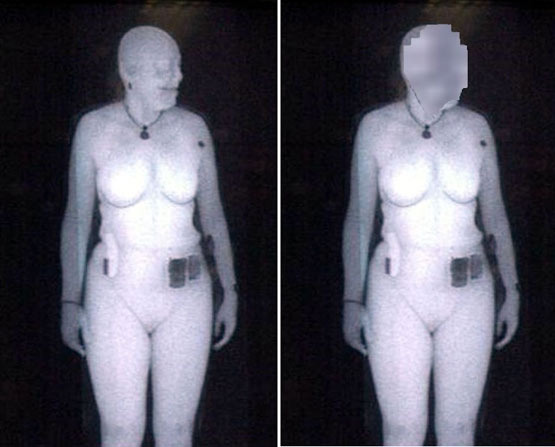
Thoughts like, "Is this harmful to my body?" and "Will my body be fully visible?" often come to mind.
To conclude, the full-body scanners currently used in most international airports operate on relatively safe technology, and privacy protection has significantly improved compared to the past.
The method primarily used today is the millimeter-wave scanner. This device utilizes electromagnetic waves in the range of about 24-30GHz, and the important point is that this wavelength is non-ionizing radiation, unlike X-rays. This means it does not have the property of damaging human cells, so it is considered to pose little risk even with repeated use. The operating principle is relatively simple. Low-output electromagnetic waves are emitted from both sides of the machine towards the body, passing through clothing and reflecting signals off the skin and objects. Based on this reflected data, the computer detects any unusual objects on the body surface.
In the past, backscatter X-ray technology was also used. This method scanned the surface of the body using low-energy X-rays, but there was much controversy due to radiation exposure, even at low levels. Ultimately, most countries, including the United States, discontinued this method in favor of millimeter-wave technology.
The biggest advantage of this equipment is that it can detect not only metal but also non-metallic substances. It can detect materials like plastic, rubber, ceramics, and liquids, providing a much higher level of security than traditional metal detectors. In fact, it plays a crucial role in detecting small weapons or hazardous materials in advance.
However, it is not a perfect technology. It can be difficult to detect objects hidden inside the body, and false alarms may occur due to artificial joints or medical devices. In such cases, additional inspections may be conducted. Additionally, in the past, scanner images were displayed in a way that closely resembled the actual human body, leading to privacy concerns, but this has been completely improved with a different method. Now, the display shows a simple silhouette rather than an actual body image, indicating only the areas of concern.
The scanning process is also straightforward. You enter the device, raise your arms, and remain still for about 2-3 seconds for the scan to complete. It is advisable to remove metal items like belts, coins, and phones beforehand. If the machine detects something unusual, additional hand checks or pad inspections may be conducted.
In summary, the full-body scanners currently used at airports are much safer and more sophisticated than in the past.
They have evolved to enhance security levels while minimizing the burden on the human body and privacy invasion. It can now be seen as an essential system for maintaining aviation safety rather than just a simple inspection device.







 candytip |
 Gold Bar |
 Pirate Ship Popcorn Maker |
 Montgomery Mom |
 Anjollinya Blog |
 Peter Pan Pet |
 Nuchuhan Exploration BLOG |
 Sugar Cream Door Bulletproof Noodles |
 Moscow Kim |
 forevergee |
  festival |
  manchester |
  constant |
  Leapfrog Move |
  vibranto |
  Tora Tora |
  yellowbutter |
  Dolly |
  US Embassy |
  NYC saladbar |
  Finding Superfoods |
  lightyear |
  song bang |
  vexomo |
  Indiana Jones |
  meloncat |
  novapixel |
  mortrix |
  Esther 1983 |