

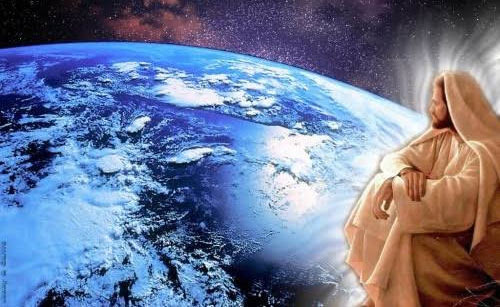
Walking on water, feeding thousands with five loaves of bread and two fish, raising the dead, and ultimately, the story of Jesus rising from death.
These are the core events that have sustained the Christian faith, and believers consider these facts to be real occurrences in history.
"God, is there really revelation?"
"Is there really an afterlife? Is it just the end when we die?"
Interestingly, we now pose this age-old question not to priests or pastors, but to AI.
Since it has consumed billions of books, we secretly hope it might reveal some cosmic secrets unknown to humanity.
But the responses we get are always deflating.
"Different religions have different views."
"There is no scientific proof."
"There are various philosophical interpretations."
In the end, AI cannot step outside the boundaries of the knowledge that humans have input into it.
Reading the Bible often brings a smile. There's a character who resembles us too closely.
It's Thomas, one of Jesus' disciples. Upon hearing the news of the resurrection, he immediately said, "I won't believe until I see it with my own eyes and put my fingers in the nail marks."
That's why we still refer to skeptical people as 'Doubting Thomas.'
We are not much different today. We turn on our palm-sized smartphones and demand answers from AI.
"God, give me your coordinates." "Prove to me that heaven exists with data."
As if AI were the manager of the universe.
But AI doesn't know the answers. In fact, it's only natural that it doesn't.
This entity is brilliant at calculations, transcribing, and summarizing, but it has never met God nor is it a witness who has returned from the dead.
It's merely a 'smart assistant' that organizes the records left by humans.
Isn't it ironic? The questions we throw at cutting-edge AI are, in fact, identical to those posed by people 2,000 years ago.
"Are you really the Son of God?" "Show me the evidence, the evidence."
Faith is not a calculation
In an era where we can view images of galaxies far away with a smartphone, we find ourselves just as lost in front of the questions of 'life and death' as people were 2,000 years ago.
Faith has a peculiar aspect. It doesn't demand blind belief.
Faith is ultimately not a result that comes from crunching numbers, but a 'response to life' that I freely throw out there.
Perhaps as technology advances, we are becoming more like Thomas.
We need to see to believe, we need data to acknowledge, and we need fact-checking to open our hearts.
Of course, this is the best attitude when it comes to science. But where do love, hope, and trust in someone get proven by numbers?
Faith likely resides right there.
So, no matter how many times we ask AI, "Where is God?" we will never receive a satisfying answer.
That question is not something to be answered by a computer monitor; it's a homework assignment that I must confront with my entire life.
Jesus gently said to the doubting Thomas, "Do you believe because you see me? Blessed are those who have not seen and yet have believed."
Whether to believe this or not, and how to digest it, ultimately remains solely my responsibility, not an algorithm's.
 MelonRap




 Florida King |
 AH LALA |
 Victory 1988 |
 Panorama Kstar |
 Giant Squid and Sweet Potato Soup |
 Min's blog |

 Live and that's it |

 Generation X |
  Caribbean |
  Let's Be Like a Salt-like City Person |
  Belgray Miscellany |
  sweetvan |
  Augusta Univ |
  Round and Round Children's Song Kingdom |
  butter 90 |
  Lando Mao |
  Washington Denzel DJ |
  LIZ Legal Information Blog |
  vegas mom |
  Sandiego Auntie |
  Premium Gas Camp |
  Things to know |
  TEXAS Fishing Boat |
  AUTO OK |
  aaoaa |
  Encyclopedia of New York and Surrounding Areas |
  Study Abroad Life Know-How Tips |