

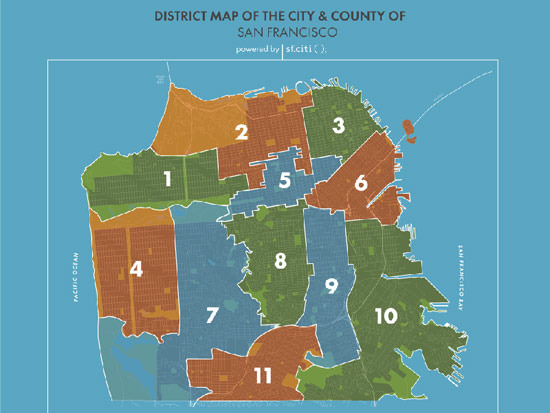
When you first encounter San Francisco, one thing that can be surprising is its administrative structure.
For those who have lived in the U.S. for a long time, the idea of "separate city and county" is almost common knowledge.
However, San Francisco slightly deviates from this norm. Here, the city and county are combined, creating what is known as a 'consolidated city-county' structure.
At first glance, it may seem complicated, but in reality, it operates quite rationally.
San Francisco is the only city in California that maintains this consolidation of city and county.
In other cities, the city hall and county office operate separately, but here, a single government handles both roles simultaneously.
In simple terms, it's a structure where "everything is resolved at once." For those unfamiliar with U.S. administration, this might actually feel more intuitive.
The center of administration is the mayor and the Board of Supervisors. The mayor is the executive head representing the entire city, while the 11 supervisors are politicians representing various districts.
These 11 districts are not just administrative divisions; they are actual units that define living areas.
Residents directly elect the supervisor who represents their neighborhood. As a result, policies often flow in a quite realistic direction. This is a structure where "neighborhood politics" are reflected in the overall governance of the city.
The Board of Supervisors is not just an advisory body. They create ordinances, approve budgets, and have the authority to approve key appointments made by the mayor. This means that the mayor cannot simply push through decisions without consideration.
As a result, checks and balances naturally arise. Therefore, when you read San Francisco political news, there are rarely quiet days. There is always some kind of debate happening. While this can feel exhausting, it also indicates active citizen participation.
To understand this city, there is something even more important than the administrative structure: the neighborhoods.
Officially, it is divided into 11 districts, but in reality, people experience dozens of 'neighborhoods.' Areas like Mission District, Castro District, Haight-Ashbury, Noe Valley, Richmond District, Sunset District, Marina District, North Beach, Chinatown, and SoMa have completely different vibes just by their names. Even though it's the same city, changing neighborhoods can alter the very atmosphere.
This is why you hear the expression that "there are multiple villages within one city" when referring to San Francisco. This is not just a sentimental expression; it is felt in everyday life. Depending on which neighborhood you live in, your way of life can change. Food, culture, atmosphere, and even political leanings can vary.
Geographically, this city is relatively small. It covers about 47 square miles. However, its population density ranks among the highest of major U.S. cities. With so many people concentrated in a small area, space utilization naturally becomes a significant issue. This is one of the structural reasons behind rising housing prices and rents. It's not just that it's "popular and therefore expensive"; it's a city that physically lacks space.
The advantages of this consolidated structure are clearly evident in administrative services. Birth registrations, marriage documents, business permits, voter registrations, and welfare services can all be processed within a single system without needing to visit multiple agencies. Most issues are resolved within the City and County of San Francisco government system. Online, you can find almost all information at SF.gov. While there is an image of U.S. administration being complex, San Francisco feels quite the opposite.
Of course, reality doesn't always run smoothly. Recent major issues illustrate this. Problems like homelessness, open drug markets, housing shortages, and public transportation improvements continue to be topics of debate. Conflicts of opinion between the mayor and the supervisors occur frequently. It's not so much about who is right or wrong; rather, it's more accurate to view the city as being in a constant process of finding its direction.
If you view this city merely as a tourist destination, you will only see beautiful scenery and a free-spirited atmosphere. However, if you delve into its administrative structure, you will see a completely different picture. It's a city where diverse people live together on a small piece of land, operating as an experiment under a single system. Thus, San Francisco is a place that is always noisy, always changing, and can be both good and bad at the same time.







 horse |
 Sunset Oregon |
 daisypat |
 Anjollinya Blog |
 Anova US Beauty Information |
 Sugar Cream Door Bulletproof Noodles |
 Nuchuhan Exploration BLOG |
 DOCTOR MED |
 U.S. Military Recruitment Information |
 Strawberry Pancake Warrior |
  rustley |
  Shim Ramen |
  Cool Beach Freeway |
  Exploring American Life Information |
  Mental Health Psychiatrist |
  element |
  Koreab Date |
  CA Real Estate |
  yolanda78 |
  Round and Round Children's Song Kingdom |
  Mia Flori |
  nova nova |
  healthy |
  leaves |
  sparkling |
  maryland park |
  persiste |
  conte |
  blueman |
  Going Once |