

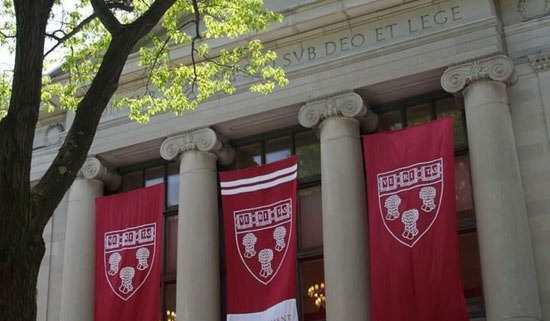
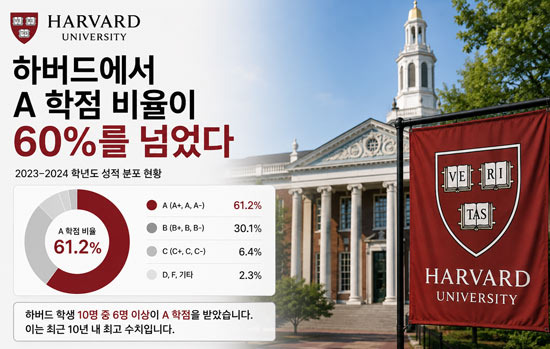
A few days ago, I came across an article about Harvard's grade distribution that made me chuckle. It states that more than 60% of students receive an A grade.
This means that if there are 30 students in a classroom, 18 of them are getting an A.
At first, you might think, "Of course, Harvard is different." But this isn't a sign that students have become smarter; it's just a signal that the system is broken.
About ten years ago, the A grade percentage was around 35%. Now it's 60%.
Let's be honest. Has the average IQ of Harvard students increased by 20 points during this time?
Have the number of perfect SAT scorers doubled? No. The pool of admitted students is almost the same. In fact, as the admissions process has shifted to a holistic review, the academic standards have become more diluted.
This means that the grading standards have collapsed. It's not that students have improved; it's that getting an A has become easier.
This is similar to inflation. When the value of money decreases, it takes twice as much money to buy the same loaf of bread.
The same goes for grades. As the value of an A decreases, students who would have received a B+ in the past are now simply getting an A.
People act according to incentives, not according to a moral textbook. The same goes for universities.
Let's think from a professor's perspective. What happens if the end-of-semester course evaluations are low? It can be detrimental during reappointment reviews. If they're on a tenure track, it can be even more critical.
It also affects grant funding. If students post on social media that "this professor gives low grades," the number of students enrolling in the next semester decreases. This impacts the department's budget as well.
On the other hand, if grades are given generously? Students are happy. Course evaluations improve. No one complains. The administration stays quiet.
So, there's zero motivation to grade strictly. It's a game where only the professor loses.
In such a structure, if grades haven't increased over 30 years, that would be the more unusual situation.
It must be rare to have value. But now, dozens of students are said to receive it together.
What does this mean? It means that the term "awardee" no longer carries any information.
When a hiring manager sees "Harvard summa cum laude" on a resume, it has become a time when they think, "So what?" The signaling value converges to zero.
Isn't that why companies in Silicon Valley don't look at GPA when hiring engineers? Because it lacks differentiation. The school isn't doing its job, so companies have to take on all the burden.
And now, with ChatGPT added to the mix
I work daily with Claude and ChatGPT. To be honest, if there's a professor who believes that today's college students write 100% of their essay assignments on their own, that person is naive.
AI detectors have too many false positives, making them practically unusable. Ultimately, professors grade based on the final product. The results are all well-written... so again, it's an A.
This is the real problem. Everyone knows that an A does not reflect a student's true abilities. Yet, the system continues to churn out A grades.
Diplomas look impressive, but no one can guarantee what's inside them.
Harvard's 20% cap is late but correct
In this situation, Harvard has introduced the "20% cap on A grades" card. It seems students are strongly opposed.
Of course. The rules of the game have changed. Until yesterday, you could get an A just by meeting a certain standard, but now you have to compete with your classmates to earn an A.
But this is the right direction. The essence of evaluation is differentiation. Giving everyone an A is not evaluation; it's a participation trophy. It might be acceptable in kindergarten, but handing out participation trophies at a world-class university is self-sabotaging.
Meritocracy starts by recognizing differences. The school needs to signal this early so that students understand their positions, and companies can hire efficiently.
If the school fails to do this, everyone ultimately loses. So, I believe that grade inflation is not just a university issue.
This recent action by Harvard may be painful for students, but ultimately, it's about preserving the value of the degree.
Stopping a system that has been sliding in one direction for 30 years is something to applaud.
Will other universities follow suit? I'm not sure. If the incentive structure remains the same, it will be difficult.
Still, someone had to start. It's fortunate that it's Harvard that took the lead.
 skyvalleydreamer1990
 OceanDreamer
 VibeReader
 PsyAcorn





 Anova US Beauty Information |
 anchor |
 Korea Tiger News |
 Alpha and Omega World |
 Florida King |
 NO CAP LIFE |
 bagel90 |
 tiramisu |
 custardnew |
 Tart Tart |
  Granola |
  joyfull yang |
  Olivia's Blog |
  Living in America and Writing Essays |
  Piano Teacher Blog |
  bearcup |
  explorer |
  dictionary |
  Mr Bull Jung |
  radiant |
  Georgia 88 |
  Great TOWN NEWS |
  Open Flex Mind |
  Hartford Blog |
  unified |
  Generation X |
  ringwinds |
  American Food Information & Calories |
  Hawaii Maui Kahului |
  calvorn |