

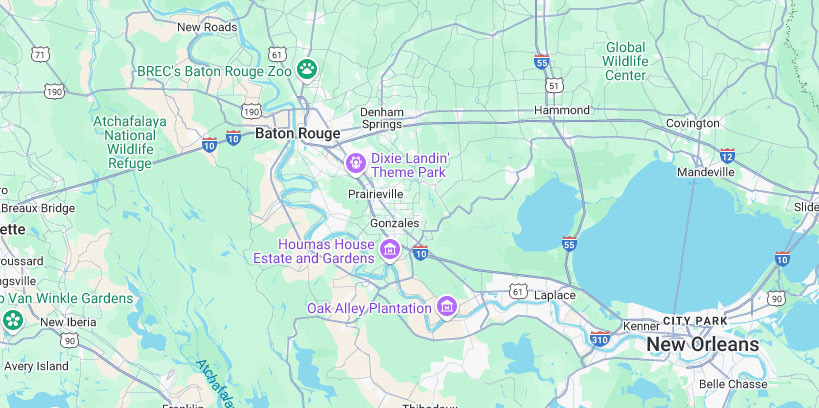
When including the metropolitan area, over 800,000 people live here, forming a core urban area in Louisiana. In terms of racial composition, Black or African American individuals make up about 59%, the highest percentage, followed by White at 32%, Hispanic and Asian at about 5% and 2% respectively, with other races making up the remainder. The age group of the working-age population (ages 18-64) constitutes 62%, while the elderly population aged 65 and over accounts for about 16%, contributing to the image of a city with retirees.
Economically, the median household income is about $54,000, and the median individual income is around $31,000, which is somewhat lower than the national average. However, this reflects positively on the stability of the city's economy, driven by key industries such as energy, education, and government agencies.
Baton Rouge is a representative energy hub in the southern United States, with a concentration of refining and petrochemical plants, which allows large energy companies to establish headquarters here, creating stable jobs. Additionally, as the seat of the state government, public services and the administrative sector play a significant role, and with Louisiana State University (LSU) at its center, education and research are thriving, fostering an academic and youthful atmosphere. The manufacturing and port logistics industries also support the economy, making it a city with a diverse industrial base.
Of course, there are challenges as well. A prominent issue is income disparity. In urban areas, high-income and low-income households coexist, leading to noticeable imbalances, while suburban areas maintain relatively stable income levels. Education levels are closely linked to income, with regions that have better educational environments tending to show higher household incomes. For example, residential areas like Evans Hills have a high concentration of middle-class households, while some industrial zones or underdeveloped areas still exhibit low incomes and limited opportunities.
Population trends indicate that Baton Rouge is steadily growing. As economic opportunities and educational environments improve, more people are migrating from other states, particularly young professionals and students. At the same time, the retired population is increasing, leading to higher demands for healthcare and welfare, suggesting potential growth in the healthcare industry in the future.
Baton Rouge maintains its economic status as both a political center and a "city of energy." Additionally, it boasts a vibrant sports culture represented by the LSU Tigers, a unique food culture characterized by Cajun and Creole cuisine, and a musical tradition that includes blues and jazz, making it a city with diverse attractions. However, the relatively low income levels and imbalance issues remain challenges to be addressed.





 ultron78 |
 garlic bread |
 Sugar Cream Door Bulletproof Noodles |
 urbanmint |
 |
| 
 cherrydino |
  ORAVEZIN Oppa |

 berrypup |
  Finding Superfoods |
  lightyear |
  song bang |
  vexomo |
  Indiana Jones |
  meloncat |
  novapixel |
  mortrix |
  Esther 1983 |
  fortbliss |
  Moscow Kim |
  My Two Way |
  toastyfox |
  FLORIDA Acus |
  tracker |
  TONTON COFFEE |
  sunrise |
  uplifted |
  Folding Instructions |