

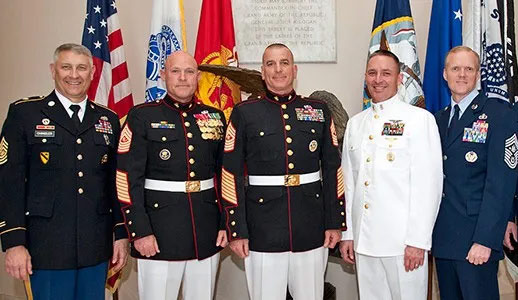
In the U.S., when serving as an officer, the first question is often about salary.
It's natural to be curious about income since being a soldier is a job.
However, listening to the experiences of those who have served as U.S. military officers reveals that there are factors considered more important than salary.
The first important factor is a stable pension system.
One of the biggest reasons U.S. military officers choose long-term service is this pension. The military has a structure where service members can receive a lifetime pension after serving a certain period. Traditionally, if one serves for about 20 years or more, they receive a monthly pension after retirement. Especially for those who have served as officers for over 20 years, the pension is at a level that allows for a fairly stable lifestyle. In American companies, the structure of receiving a lifetime pension after 20 years of service has almost disappeared, making this system still highly valued.
Another important point is healthcare benefits. Healthcare costs in the U.S. are often much higher than expected. It's common for a single visit to the emergency room or a simple surgery to cost thousands of dollars. However, during military service, most treatments can be accessed through the military healthcare system. Active-duty service members and their families also receive healthcare benefits within certain limits. Even after retirement, they can access medical services at relatively low costs through military healthcare systems or related insurance programs. Considering that healthcare costs are a significant burden in American society, this benefit holds value beyond mere welfare.
The third important factor is educational benefits. The military places a high value on education. Therefore, various educational support programs are provided not only to officers but to all service members. A representative program is the GI Bill, which offers educational support. Utilizing this program can help cover college tuition or graduate school fees. Some programs even provide living expenses. As a result, many service members return to college or graduate school to prepare for new careers after their service. Officers also receive various specialized training and leadership education within the military. These experiences often help in continuing careers in civilian companies after leaving the military.
Another notable aspect is housing-related benefits. Military officers may receive military housing or housing allowances depending on their duty station. This allowance is adjusted according to local living costs, significantly reducing the burden of living expenses. In major U.S. cities, housing prices and rents are quite high, making this housing support very valuable.
The experience and network gained while serving as an officer are also important factors. The military is a highly organized structure, providing a good environment for gaining leadership experience. Many young individuals manage organizations ranging from dozens to hundreds of people. Such experiences are highly valued in civilian companies. In fact, many companies prefer candidates with military officer backgrounds due to this leadership experience.
Ultimately, when evaluating the profession of an officer in the U.S., focusing solely on salary often fails to capture the full picture. Long-term factors like pensions, healthcare benefits, and educational support must also be considered. When combined with housing support and leadership experience, the value of being an officer transcends mere salary.
Thus, among military officers, it is often said that military life is not just a job but a part of long-term life planning.
In reality, many officers choose to transition to civilian life after accumulating experience and benefits through a certain period of service, or they may opt for a career that continues until retirement in the military. These aspects contribute to why the profession of an officer remains an attractive option in the U.S.
 IndianaYo





 washington mom |
 Victory 1988 |
 El Dorado |
 lightyear |
 Moscow Kim |
 Peter Pan Pet |

 Nuchuhan Exploration BLOG |
 Sugar Cream Door Bulletproof Noodles |
  United States National Administrative Organization Stories |
  springwaltz |
  dense |
  Tiger Milk Foam Research Institute |
  Oreore Mushroom |
  optimistic |
  Good Good |
  berion88 |
  bravo777 |
  skyblue |
  Project Tomorrow |
  apricotla |
  Soy Angelino |
  nati8 |
  NE Hodori Preik |
  celtics |
  Balancework |
  round1 |
  Way to easy |