

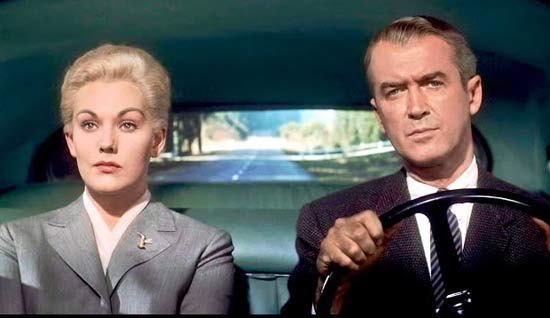
Initially overlooked, now regarded as one of the greatest films in the world, Hitchcock's 'Vertigo'
Now considered one of the greatest works in film history, Vertigo did not achieve the expected success upon its release in 1958.
At the time, audiences and critics viewed the film as nearly a failure and did not regard it as Hitchcock's best work.
The reason for this can be traced back to the 1950s in America, a period of rapid economic growth following World War II.
People were dreaming of an optimistic future, and theaters were filled with glamorous musicals, westerns, and large-scale historical films.
In fact, audiences of that era preferred straightforward and easily understandable stories over complex psychological dramas.
In such a context, 'Vertigo' was too unique.
This film is neither a detective story about catching a criminal nor a simple romance.
It is much closer to a very uncomfortable psychological drama that mixes obsession, desire, fantasy, and reality.
Especially in the latter half of the film, it deliberately breaks the traditional thriller structure that audiences expect.
The box office performance was also below expectations.
Despite featuring Hollywood's top stars, James Stewart and Kim Novak, it did not achieve explosive success relative to its production costs.
Some critics even described the film as too long, depressing, and difficult to understand.
However, as time passed, the evaluation changed completely.
Since the 1970s, film scholars and critics have begun to reanalyze 'Vertigo.'
They see this work not merely as a thriller but as an artistic piece that dissects human psychology.
The protagonist, Scotty, is not simply in love with a woman.
He loves the fantasy he desires.
And he becomes increasingly obsessed with making that fantasy a reality.
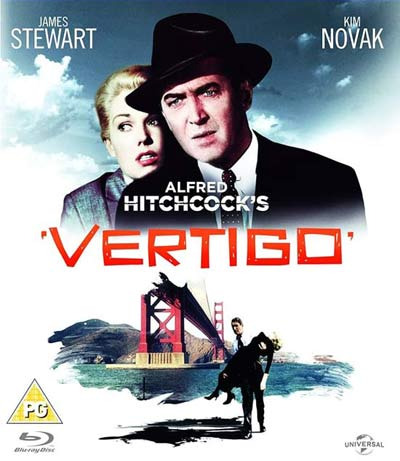
From today's perspective, this film is more about obsession, control, and desire than a love story.
Thus, it resonates even more strongly with modern audiences.
One reason film critics hold this work in high regard is its visual language.
Hitchcock used the famous 'Dolly Zoom' technique to express the protagonist's fear.
The strange image of the background receding while the character remains the same when looking up the stairs still appears in film school textbooks today.
Since then, many directors have emulated this technique.
Another important aspect is the city of San Francisco itself.
While many films use cities as mere backdrops, in 'Vertigo,' San Francisco functions almost like a character.
The foggy Golden Gate Bridge, the endless winding hills, the sea and cliffs, and the atmosphere of old cathedrals and graveyards add a sense of mystery to the entire film.
As a result, even today, when film fans visit San Francisco, they often embark on a 'Vertigo tour' to find the film's locations.
This is also why Korean film critics frequently mention this work.
'Vertigo' is not just an entertaining film; it serves as a textbook on how to make a film.
Camera movement, color usage, music, editing, spatial utilization, and character psychology expression become subjects of study.
Especially in the Korean film industry, the influence of Hitchcock is often mentioned when analyzing the works of auteur directors like Park Chan-wook and Bong Joon-ho.
Thus, 'Vertigo' is regarded as one of the roots of modern cinematic grammar.
In 1958, audiences did not fully grasp its true value, but decades later, filmmakers rediscovered this work.
And finally, in 2012, it was ranked as the greatest film of all time by the British Film Institute (BFI), pushing aside 'Citizen Kane,' which had long held the top spot.
Ultimately, 'Vertigo' was a film that was ahead of its time.
 SkyBlog
 BreadDefense
 AcornHeight


 Day by day |
 Kitchen Ideas |
 Iowa Egen Aunt |
 Beauty, Health, Lifestyle Blog |
 Always Atlanta |
 Peter Pan Pet |
 Sugar Cream Door Bulletproof Noodles |
 Nuchuhan Exploration BLOG |

 Strawberry Pancake Warrior |
  Finding Superfoods |
  lightyear |
  song bang |
  vexomo |
  Indiana Jones |
  meloncat |
  novapixel |
  mortrix |
  Esther 1983 |
  fortbliss |
  Moscow Kim |
  My Two Way |
  toastyfox |
  FLORIDA Acus |
  tracker |
  TONTON COFFEE |
  sunrise |
  ultron78 |
  uplifted |
  Folding Instructions |