

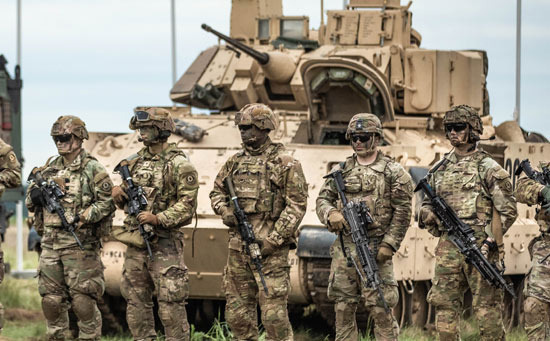
When joining the Army as a soldier in the U.S., people often say, "It's a stable job since you're a career soldier," or "I've heard the benefits are good."
Well, these statements are somewhat true. A U.S. Army soldier is indeed a career soldier, receiving a salary, insurance, and less worry about housing costs. The issue lies in the trade-offs. Considering that, if you ask whether it's a good choice, I honestly think it's a difficult question to answer easily.
First, looking at the pay, the reality is a bit harsh. The monthly salary for new recruits at the E-1 and E-2 ranks is slightly better than minimum wage for full-time work before taxes. Of course, you have to consider that food and housing are provided, and living on base means you spend almost nothing on rent or food. However, when you think about the "difficult training + discipline + restrictions on freedom," it demands too much to simply compare it to a convenience store job. While pay increases with rank, for the first few years, it can be embarrassing to say you went to make money.
The benefits are definitely a plus. There's almost no worry about health insurance, and if you get married, you receive housing support. After serving for a certain period, you can also receive education benefits and perks like VA loans. This is something to acknowledge. Especially for those from difficult financial backgrounds or who find college tuition burdensome, it's certainly an attractive option. However, to fully enjoy these benefits, there are conditions. You must complete your contract, and if you leave early, a significant portion disappears. It's not a concept of "you get it if you endure" or "you get it if you join."
So, what about the training? If you ask, it's tough. Really. Especially basic training drains both physical and mental strength. Early morning wake-ups, endless running, repetitive commands, and almost no personal time. They package this as "training," but for those who aren't suited for it, it's just a stress factory. The problem is that this doesn't end with training. Discipline continues after deployment. The concept of commuting is vague, and you're always in a state of readiness. Weekends aren't completely free either.
So many people ask, "Isn't it better to just work in society for this level of difficulty?" Honestly, this question is quite honest. If you're prepared for physical work, confident in following rules, and want a stable long-term path, the military might be right for you. But if you're just looking to make money or think it will be stable, the chances of regret are high. Using the same physical strength and patience in society can often yield more money and freedom.
Ultimately, the biggest downside of being a U.S. Army soldier is the lack of choice. Where to go, what to do, and when to rest are mostly decided by higher-ups. In society, if you don't like something, you can at least consider changing jobs, but that's not an option in the military. A contract is a contract. It's hard to get out midway just because you feel, "This isn't for me."
In summary, being a soldier in the U.S. Army is certainly a job with benefits. However, those benefits are not free. It's a structure where you pay upfront with your freedom, time, physical strength, and mental resilience. Training is tough, life is demanding, and initial pay is often below expectations. Therefore, this path should be taken not because you can, but when there is a clear reason to do so. Otherwise, it might be better to work hard for money in society.





 My NYC |
 coloradoman |
 Living Economy Information Blog |
 Tomato Health Club blog |
 Banana Style Life |
 productionblog |
 Big North |
 fernando park |
 U.S. Military Recruitment Information |
 US Embassy |
  Korean Mom |
  moo moo |
  Mr Oh |
  forevergee |
  festival |
  manchester |
  constant |
  Leapfrog Move |
  vibranto |
  Tora Tora |
  yellowbutter |
  Dolly |
  NYC saladbar |
  Finding Superfoods |
  lightyear |
  song bang |
  vexomo |
  Indiana Jones |