

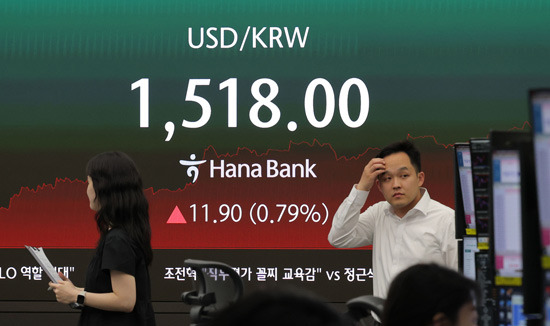
The exchange rate, which exceeded 1300 won in 2022, is now around 1520 won today.
When discussing exchange rates, most people say things like "it's beneficial for export companies" or "it's part of the economic cycle."
However, for those receiving remittances in Korea, this is an emergency situation.
It is particularly serious for families in Korea who send living expenses to family members in the U.S. every month.
Many people simply think, "Since the exchange rate has risen, sending dollars to Korea means the recipient will get more won, so they must benefit, right?" This one-dimensional thinking overlooks the realities of the financial market and the sender's financial situation, leading to completely different outcomes.
For example, consider a household in Korea that lives on a monthly income of 5 million won. As the exchange rate skyrockets, the amount of dollars that can be sent to the U.S. inevitably decreases. From the sender's perspective, they have to adjust the amount based on dollars, which makes the recipient feel like the effective amount has decreased by nearly 20%.
This becomes a problem because living expenses in Korea are mostly fixed in won.
Rent, utility bills, food costs, and education expenses continue to rise or at least remain stable regardless of the exchange rate. However, if the money coming in from abroad decreases, individuals must bear that difference themselves. This impact is even more pronounced in cases where parents send living expenses, families support students studying abroad, or foreign workers remit money back home.
For fathers sending money to Korea, parents of international students, or immigrants, their income is fixed in 'dollars.' Just because the exchange rate has risen doesn't mean their dollar salary suddenly increases.In the past (exchange rate 1,300 won): To match 5 million won, $3,846 was sent.
Now (exchange rate 1,530 won): To match the same 5 million won, only $3,268 needs to be sent.
When you factor in remittance fees and exchange spreads, the actual feeling is that the amount has decreased by more than 15%, approaching 18-20%.
Thus, depending on the sender's dollar burden structure, it is entirely possible for the amount received to decrease significantly.
Looking at the background of this exchange rate rise, it is difficult to view it as a simple temporary phenomenon.
Global government bond yields are rising, and international oil prices are maintained at around $100 per barrel, increasing inflationary pressures.
Additionally, tensions between the U.S. and Iran remain unresolved, keeping the risks in the Strait of Hormuz alive, and investors are naturally moving towards the safe asset, the dollar.
The outflow of foreign capital from the Korean stock market is also a factor that further stimulates the rise in the exchange rate. Ultimately, the dollar becomes stronger while the won weakens.
The problem is that there is a possibility that this trend will not end in the short term. If the exchange rate remains in the 1500 won range for an extended period or rises further, families dependent on remittances will inevitably face structural adjustments in their living expenses.
This could lead to situations where they have to change their living arrangements or reduce education expenses, rather than simply cutting back on consumption.
Therefore, what is important now is to view the exchange rate not just as a news number but as a personal financial strategy.
Both senders and recipients need to reconsider their plans by taking into account both dollar and won perspectives. An increase in the exchange rate does not automatically mean a benefit or disadvantage; the outcome can vary completely depending on how the money moves.
 WisconDriver
 TunaDance
 PuddingLover







 crystalo |
 Investment Beginner Company Information Encyclopedia |
 Always Dreaming of Big Success |
 happy 9 |
 coloradoman |
 American Food Information & Calories |
 OC Real Estate Business Information |


 Banana Style Life |
  Tesla X |
  Old English |
  urbanmint |
  forestcloud |
  forever young |
  Arlington house |
  liquid asset |
  Who's watching? |
  eclipse |
  quietwave |
  Hajiwon Blog Hair Salon |
  hoosierdaddy |
  saffronroute |
  korvex93 |
  Mini Mee |
  Darnignac |
  vanilla |
  selvon |
  brownie |