

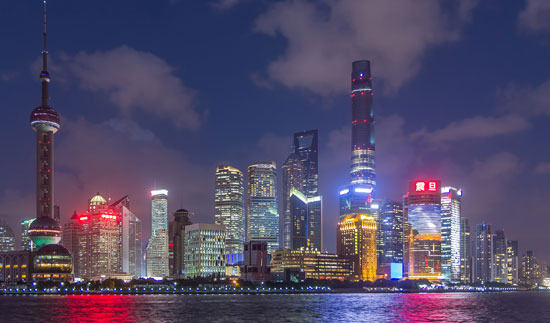
These days, when watching international news, it is common to hear that "China has surpassed Russia to become the de facto second-largest military and economic power in the world."
During the Cold War, the perception was that the military power hierarchy was dominated by the US and the Soviet Union, with other countries far behind. However, that picture has completely changed. This shift is not just a matter of a few numbers being flipped; it is the cumulative result of how China has moved and the direction it has taken.
The most decisive difference is the scale of the economy. Russia remains a strong country in nuclear weapons, missiles, and aerospace technology, but its economic structure is very simple. It heavily relies on oil, gas, and raw materials, with a thin manufacturing base. While it can endure a prolonged war, its capacity to upgrade industries and expand technology in the long term is limited.
In contrast, China has expanded its scale in almost all industrial sectors over the past 30 years, including factories, ports, railways, semiconductors, telecommunications, electric vehicles, batteries, shipbuilding, and solar energy. Military power ultimately derives from money and industry. Tanks, fighter jets, and missiles are produced in factories, and the strength that operates those factories is the economy.
The second factor is the technology ecosystem. Russia traditionally excels in military technology but has weak connections to civilian technology. While its defense industry is strong, it struggles to extend that technology to civilian sectors like smartphones, semiconductors, artificial intelligence, and robotics. Conversely, China has intertwined civilian and military technologies almost as a single flow. As private companies grow in areas like drones, artificial intelligence, satellites, telecommunications, autonomous driving, and precision manufacturing, their capabilities naturally flow into the military sector. This is known as the military-civil fusion strategy. As a result, China has established a structure that allows it to produce the latest military equipment more quickly, in greater quantities, and at lower costs.
The third factor is the population and talent pool. Russia's population is declining and aging rapidly. Many young technical talents are leaving for the West. In contrast, China continues to produce a large number of engineers, scientists, and technicians based on its vast population. Cities like Beijing, Shanghai, Shenzhen, and Hangzhou attract world-class research talent, and the country invests heavily in strategic fields like semiconductors, aerospace, and artificial intelligence. Military power ultimately comes from the quality and quantity of people.
The fourth factor is the direction of military power. Russia still maintains a continental-centered military strategy, focusing on traditional military power aimed at Europe and Central Asia. Tanks, artillery, and large ground forces are key. However, the center of modern military competition has shifted to areas like naval, air, space, cyber, drones, and missile defense systems. China has accurately read this trend and has significantly expanded its capabilities in aircraft carriers, large destroyers, hypersonic missiles, satellite networks, radar systems, and drone forces. It is creating a military structure that encompasses the sea, sky, and space.
The fifth factor is geopolitical location. Russia is adjacent to Europe, leading to constant clashes with the West. After the Ukraine war, it has faced economic sanctions and restrictions on technology imports, slowing its military modernization. In contrast, China has expanded its influence centered on the Asia-Pacific while adopting a strategy to avoid direct confrontation with the US. It is building military power while avoiding full-scale war and maintaining a globally connected supply chain economically. This difference has created a significant gap in long-term power accumulation.
The sixth factor is the method of national governance. Russia's power structure is relatively rigid, and internal reforms have become more difficult amid war and sanctions. In contrast, China has a system where the central government sets long-term plans and consistently pushes industrial policies. Goals like semiconductor independence, military modernization, space development, and naval expansion are pursued over decades. Slow but steady accumulation has ultimately led to surpassing Russia.
As a result, China's rise to become the second-largest military and economic power, surpassing Russia, is not a sudden occurrence. The scale of the economy, industrial base, technology ecosystem, population structure, military strategy, and geopolitical environment have all accumulated in the same direction. It may be more accurate to say that rather than Russia weakening, China has grown too quickly.
This change is not merely a matter of a ranking shift. It signals how the global order may be restructured in the future. In a structure centered on the US and China, Russia is increasingly being pushed into a secondary position. In terms of military power, economic strength, and technological capability, China is now operating at a level above Russia.
The era we live in is no longer a simple US vs. Russia scenario from the Cold War. A new axis of US vs. China has emerged, and many countries are now balancing between them. Understanding why China has surpassed Russia is, I believe, the starting point for understanding the future world.







 Moscow Kim |
 coloradoman |
 Montgomery Mom |
 GOGO SING |
 Hajiwon Blog Hair Salon |
 Weekend Movie Blog |
 Beauty, Health, Lifestyle Blog |
 Superman Cat Blog |
 novapixel |
  Korean Mom |
  My NYC |
  moo moo |
  Mr Oh |
  forevergee |
  festival |
  manchester |
  constant |
  Leapfrog Move |
  vibranto |
  Tora Tora |
  yellowbutter |
  Dolly |
  US Embassy |
  NYC saladbar |
  Finding Superfoods |
  lightyear |
  song bang |
  vexomo |
  Indiana Jones |