

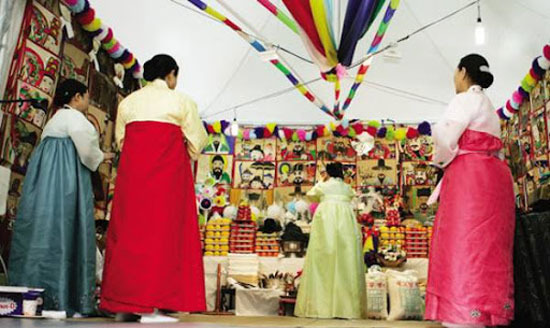
Living in the U.S., one often encounters stories related to the unique shamanistic beliefs of Koreans within the Korean community.
In the U.S., there are indeed individuals who live as those who have received 'shinnaerim' in the context of Korean shamanism. However, the manifestations of this experience differ somewhat from those in Korea. The immigrant experience itself often comes with significant stress and identity confusion, leading to cases where individuals from shamanistic families or those who have experienced shinbyeong since childhood find their symptoms worsening after arriving in the U.S., resulting in a delayed experience of shinnaerim.In particular, in areas with dense Korean populations such as LA, New York, Seattle, Atlanta, and Chicago, Korean shamans actively operate fortune-telling businesses or perform rituals, some of whom have fully embraced the path of a shaman after immigrating to the U.S.
This process often begins with mental and physical symptoms. Individuals may experience unexplained insomnia, auditory hallucinations, extreme anxiety, panic, physical pain, and a loss of reality, and even after medical examinations show no abnormalities, they may interpret their experiences as shinbyeong through consultations with family or acquaintances.
In American society, such phenomena are often diagnosed as mental health issues, but within the cultural context of the individuals and their families, they are frequently accepted as shinnaerim.
Thus, in shamanistic stories, the structure of inheritance from grandmother to mother to daughter is particularly prevalent. In fact, when listening to shamans' stories, it is very common to hear phrases like "my grandmother had shinbyeong" or "there was a shaman on my maternal side."
However, this does not mean that such experiences are exclusively passed down through the maternal line. In reality, there are many cases where similar phenomena occur on the paternal side as well, and some families exhibit a general emotional vulnerability characterized by anxiety, depression, and emotional repression. The trauma, anxiety tendencies, and inability to properly express emotions accumulated within certain lineages continue through generations, sometimes manifesting as shinbyeong or shinnaerim experiences. Therefore, it is more realistic to view this not simply as "due to maternal lineage," but rather to consider the overall emotional atmosphere and psychological legacy of the family.
From a contemporary perspective, many phenomena referred to as shinnaerim are actually intricately linked with strong stress, identity confusion, emotional repression, anxiety or depression, and sometimes dissociative symptoms. In Korean shamanistic culture, this state has long been described as "the call of the gods," and the way this explanation has been passed down has solidified the expression "maternal lineage."
In summary, while the belief that shinnaerim is passed down through the maternal line is a strong cultural perception within Korean shamanistic tradition, it is not an absolute biological rule. In reality, the emotional structures, traumas, and psychological atmospheres accumulated within a family play a more significant role in how these experiences are expressed in the next generation. Therefore, it is more persuasive to consider not just "it's due to maternal lineage," but rather to examine "what emotions and wounds have been passed down in this family."
In this context, many individuals seek both Western medical treatment and traditional shamanistic solutions simultaneously. It is not uncommon for people to receive medical examinations and consultations while also seeking out fortune-tellers or shamans. This process can lead to conflicts and confusion between scientific treatment and traditional beliefs, but it can be seen as a very natural response reflecting the cultural identity of Koreans.
Above all, it is crucial to recognize that the suffering experienced by those undergoing these experiences is not trivial. Cultural beliefs should be respected, but at the same time, medically validated mental health treatments must also be pursued. Anxiety, depression, auditory hallucinations, sleep disorders, and abnormal physical sensations often require professional evaluation and treatment.
To truly understand this phenomenon, it is necessary to view it not merely as a matter of belief, but as a complex phenomenon where culture, psychology, and social structures interact together.




 Korean Mom |
 novapixel |
 Peter Pan Pet |
 horse |
 Sunset Oregon |
 Weekend Movie Blog |
 Beauty, Health, Lifestyle Blog |
 coloradoman |
 Superman Cat Blog |
 laro90 |
  MEDBIO American Doctor Blog |
  SWAT TEAM BLK |
  DREAM BIG |
  frostbite |
  330 Forever My Love |
  El Dorado |
  dralix58 |
  Gorama Round |
  Skydiving |
  dreamport |
  Yellow Snowman |
  Toaster Pizza Magic Show |
  velvetnom |
  Anytime Journey |
  Mrs. Duluth |
  jaxter |
  Atlanta Mama |
  Baguette Blog |
  Tan Sol |