
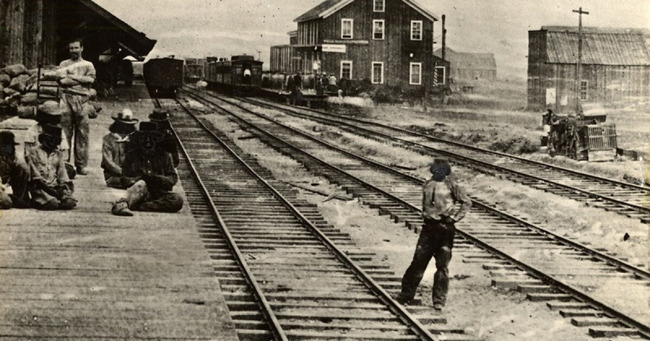
Reno is a city located at the foot of the Sierra Nevada mountains and has grown alongside the history of western railroads in the United States.
Today, it is known as a city of casinos and tourism, but Reno's beginnings were marked by the miraculous sounds of steam locomotives.
In the mid-19th century, the American West was bustling with a gold rush. The California Gold Rush erupted in 1849, causing countless people to flock to the West. However, at that time, the routes across the continent were treacherous, and travel took months.
Then, in the 1860s, the U.S. government approved the construction of the Pacific Railroad.
This railroad began in eastern Nebraska, crossed the Rocky Mountains, passed through the Sierra Nevada, and extended to San Francisco. Once completed, it would connect the East and West of the United States for the first time.
One of the cities that emerged during this process was Reno. In 1868, the Central Pacific Railroad established a stop in northern Nevada, which became Reno.
It is said that Charles Crocker, the chief engineer of the railroad construction, named the city after the Civil War hero Jesse Reno.
With the completion of this railroad, Reno quickly rose to prominence as a transportation hub.
People flocked to every stop where trains halted, shops began to open, and the city started to grow. Miners who extracted gold and silver from the mines came to supply goods, and western pioneers would stop by as well.
Thanks to this, Reno served as a central hub for early western transportation and logistics. Later, in the early 1900s, with the advent of automobiles, Reno became a center for road transportation alongside railroads, establishing itself as a 'mid-city in the desert' with the Interstate 80 running through it.
Interestingly, the railroad allowed Reno to become a center of social change beyond just a simple stop. When Nevada legalized gambling in the 1930s, people flocked to Reno by train in search of money and opportunities, and Reno soon became known as 'America's Little Las Vegas.'
However, Reno is a gambling city that is much older than Vegas. Having grown alongside the railroad, the movement of people was synonymous with the flow of money. At that time, Reno's train station was not just a place for boarding and alighting but a gateway where dreams and hopes passed through.
Surrounding the Reno station were traveler accommodations, theaters, bars, and casinos, where new businesses, romances, and even divorces took place among the people who met there. This is one of the backgrounds that made Reno "The Biggest Little City in the World."
The fate of the city flowed along the paths laid by the railroad, and along those paths, culture emerged and people gathered.
Today, if you visit downtown Reno, the old train station still remains. Alongside the tracks, cafes and galleries converted from old freight warehouses line the streets, and at night, the lights of the casinos still sparkle. But behind those lights lies the long history of the western railroad and the stories of the people.






 moo moo |
 ultron78 |
 garlic bread |
 Sugar Cream Door Bulletproof Noodles |
 urbanmint |
 Nevada Teppanyaki |

 zoryan |
 Marisol |
  Tonky |
  viroma |
  cookie |
  Live and that's it |
  Alright Twain |
  eatontown blog |
  HAWAII Korean Church News |
  Amore |
  linex |
  Balancework |
  laro90 |
  MEDBIO American Doctor Blog |
  SWAT TEAM BLK |
  DREAM BIG |
  frostbite |
  330 Forever My Love |
  El Dorado |
  dralix58 |
  Gorama Round |
  Skydiving |