
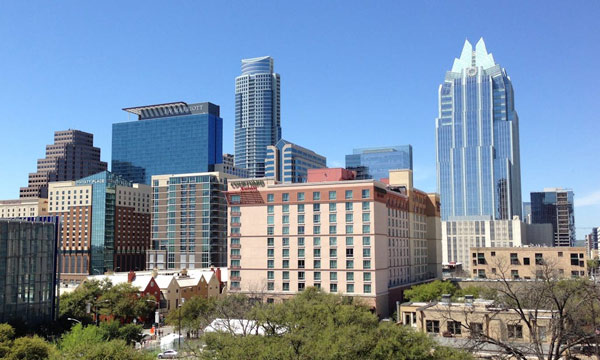
Austin is one of the fastest-growing cities in Texas, showing remarkable economic growth in recent years. This city is not only the capital of Texas but has also established itself as an economically significant hub in the United States. The factors driving Austin's economic growth are rooted in the convergence of various industries and innovative changes, leading to a very positive economic outlook for the future.
We will analyze in depth the key industries driving Austin's economic growth, the challenges it faces, and the future economic outlook.
Growth of the Technology Industry
One of the main factors driving Austin's economic growth is the technology industry. Austin has quickly established itself as an important center in the tech industry, earning the nickname "Silicon Hills" in comparison to Silicon Valley. The city is home to many tech startups as well as global tech companies.
Global IT companies such as Apple, Google, Microsoft, Samsung, and Dell have branches in Austin, significantly impacting the local economy. In particular, Apple is currently constructing a new campus in Austin, which is expected to have a significant impact on the local job market. The reasons these large corporations choose Austin include relatively low taxes, excellent infrastructure, and a wealth of skilled talent.
Additionally, Austin is emerging as a mecca for many tech startups. The venture capital and startup ecosystem is thriving, attracting many entrepreneurs to relocate to Austin. As a result, the technology industry occupies a significant portion of Austin's economy and will act as a key driver of economic growth in the coming years.
Music and Cultural Industry
Austin is also well-known as a center for music and culture. With the nickname "Live Music Capital of the World," Austin is famous for its diverse music festivals and performances. The city hosts world-renowned festivals related to music, film, and technology, such as SXSW (South by Southwest), which have a significant impact on Austin's economy. SXSW is not just a music event; it has also become an important platform for introducing innovative technologies and business ideas.
The music and cultural industries are closely linked to tourism, with many visitors coming to Austin each year to participate in performances and cultural events. Austin's cultural and artistic industries inspire creative and innovative companies, which are closely tied to the city's economic growth.
Moreover, due to its unique cultural characteristics, many young talents are moving to Austin, further diversifying the city's economy. The music and cultural industries hold significance beyond mere economic activity, showcasing Austin's unique charm to the world.
Education and Research
Austin boasts excellent education and research infrastructure, playing a crucial role in economic growth. The University of Texas at Austin is a globally renowned institution, producing numerous skilled talents. The university also plays an important role as a research institution, creating innovative technologies and ideas through various research projects and collaborations with businesses.
Education and research significantly impact not only Austin's technology industry but also various fields such as life sciences, medicine, and engineering. For example, the University of Texas conducts world-class research in life sciences and biotechnology, contributing significantly to the development of Austin's life sciences industry. Additionally, Austin's educational and research institutions supply excellent talent to businesses, providing a foundation for the growth of various industries.
Real Estate and Infrastructure Development
Austin is one of the rapidly developing cities in recent years, leading to a booming real estate market. The population of Austin is increasing rapidly, resulting in a surge in housing demand. The real estate market is particularly seeing high demand for residential, commercial properties, and office spaces, which significantly impacts Austin's economy.
As new companies establish headquarters or branches in Austin, the demand for commercial real estate is also skyrocketing. In particular, the increase in tech companies has led to a high demand for commercial office space in Austin, driving the growth of the real estate market.
Furthermore, Austin is also undertaking large-scale development projects related to transportation infrastructure. For example, the Austin-Bergstrom International Airport is undergoing expansion, serving as a crucial element supporting travel and business activities. Improvements in transportation networks and infrastructure expansion are vital factors supporting the continuous growth of Austin's economy.
Green Energy and Sustainability
Austin places a strong emphasis on sustainability, with rapidly growing industries related to green energy. The city has established itself as a hub for renewable energy, developing innovative technologies in solar, wind, and energy efficiency. One of the city's goals is to evolve into a city that uses 100% renewable energy.
In this regard, Austin is developing green buildings and sustainable transportation systems, providing new opportunities for the local economy. Additionally, as sustainable industries thrive, Austin is becoming a hub for companies developing environmentally friendly technologies. These changes will play a crucial role in advancing Austin into a more sustainable city.
Economic Challenges and Issues
While Austin's economy has a very positive outlook, several challenges exist. First, there is the issue of rising housing prices. The rapidly increasing population and influx of businesses have led to high demand in the housing market, causing prices to soar. This may make it difficult for low-income and middle-class residents to secure housing, potentially negatively impacting the city's economic growth.
Second, there is the issue of traffic congestion. As Austin's population surges, traffic congestion has become a serious problem. This affects the quality of life for residents and can be a significant consideration for businesses choosing to locate in Austin. Expanding transportation infrastructure and improving efficiency will be major challenges for Austin in the future.
Third, there is an imbalance in the job market. Economic growth in Austin is primarily concentrated in the technology sector and high-skilled jobs. As a result, highly skilled talents in the tech industry can find abundant job opportunities, while other sectors may face limited employment opportunities. It is important to create job opportunities across various industries to address this issue.
Austin is a rapidly growing city where various industries are converging around the technology sector. It shows potential for economic growth in areas such as education, music, culture, real estate development, and sustainable energy, and these growth factors will further strengthen Austin's economy in the future. However, challenges such as rapidly increasing housing demand and traffic issues also need to be addressed. By overcoming these challenges, Austin will continue to grow as an important hub in Texas and the U.S. economy.








 quanta7 |
 Living with a Consistent Heart |
 U.S. Weather Bureau News |
 |
| 
 Dallas Fort Worth DFW |
  Tonky |
  viroma |
  cookie |
  Live and that's it |
  Alright Twain |
  eatontown blog |
  HAWAII Korean Church News |
  Amore |
  linex |
  Balancework |
  laro90 |
  MEDBIO American Doctor Blog |
  SWAT TEAM BLK |
  DREAM BIG |
  frostbite |
  330 Forever My Love |
  El Dorado |
  dralix58 |
  Gorama Round |
  Skydiving |