

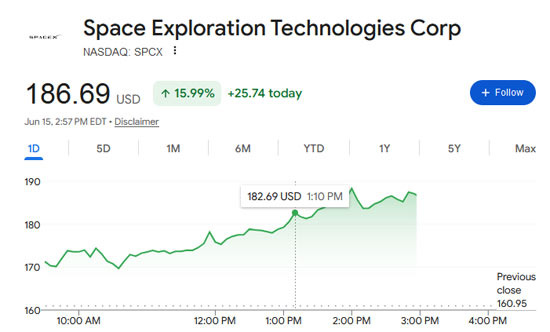
On June 12, 2026, SpaceX officially listed on the Nasdaq under the ticker 'SPCX'.
A record-breaking $75 billion (approximately 100 trillion won) IPO celebration took place, and the public cheered as they could now board Elon Musk's spacecraft.
Honestly, the stock closed on its first day up 19.22% from the offering price ($135.00) at $160.95, and on its first full trading day, June 15, it even surpassed the $187 mark, which was quite thrilling.
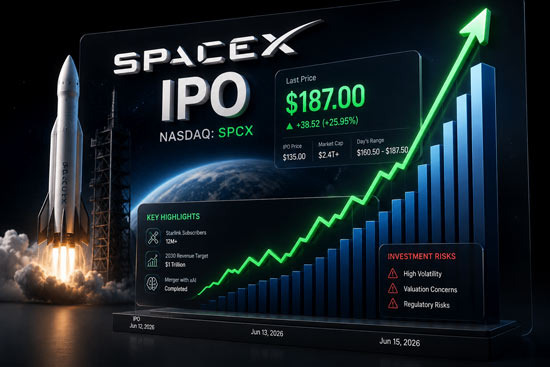
The market capitalization quickly exceeded $2.4 trillion (about 3,100 trillion won).
Positioned alongside giants like Nvidia and Apple, it secured the 6th spot in the U.S. stock market, making one feel justified in saying, "See, I told you so!"
However, in the corner of the party filled with cheers, some are calculating coldly and asking very different questions.
Romantic Investors vs. Realistic Musk
The most interesting comedy during this IPO process was the desperate unrequited love of Korean retail investors. They pooled trillions of won to participate in the domestic offering, but the result was a dismal '0 shares allocated'. While Wall Street's massive capital and institutions swept up the shares, individual investors were left with nothing.
So what can retail investors do now? They can only buy shares at a premium, paying much more than the $135 others received, at real-time prices in the $180 range.
What is the essence of the shares bought at such a high price? The public consumes grand 'sci-fi romance' ideas of colonizing Mars, the magnificent launch of the Starship rocket, and humanity becoming a multi-planetary species. However, the harsh capital market classifies SpaceX not as a space exploration company but as a 'satellite internet subscription service (SaaS) company'.
The only pillar supporting SpaceX's unrealistic $2.4 trillion valuation is not rocket science, but the 12 million Starlink subscribers who consistently pay their internet fees every month without fail. The value of the shares you bought depends not on whether you plant a flag on Mars, but on whether you can maintain your subscription without canceling it from a remote mine or a cruise ship at sea. The Mars colonization plan, to be blunt, will be the largest 'cost center' that will consume astronomical amounts of money for decades to come.
The 'Trillion Dollar Revenue' Hype and AI Delusions
Immediately after the IPO, Elon Musk made a provocative statement on social media, claiming that achieving $1 trillion (approximately 1,300 trillion won) in revenue by 2030 is possible.
The stock market cheered, but let's calculate coldly. The current price-to-sales ratio (PSR) of SpaceX is alarmingly overvalued compared to its revenue scale.
To hit $1 trillion in revenue in five years, it must achieve miraculous exponential growth without stagnation every year.
Moreover, it has recently added the 'AI synergy', the market's latest obsession. After acquiring Musk's AI startup xAI in early 2026, the market has been spinning tales of an unbeatable space AI company born from the combination of space infrastructure and AI data centers.
The current SPCX stock price is mixed with the following assumptions:
Permanent global monopoly in the Starlink communication market
Successful entry into the AI data center market
Monopolistic dominance in the space logistics market
Commercial success in the Mars exploration business
One of the bad habits of the stock market is that it prices in numerous potential future success scenarios—whether they will happen or not—'simultaneously and with 100% probability' at current prices.
If just one of these gears misaligns, or if technical flaws or regulatory risks arise, the inflated expectations could boomerang and crash the stock price. This is why a few sane analysts on Wall Street, including Morningstar, warn that "the market is in a short-term overheating state, so stop entering now."
Great Companies vs. Good Stocks
Historically, the hottest IPOs have often turned out to be the worst investments.
Among the innovative companies that everyone jumped into on the first day, claiming they would change the era, there are countless cases where their stock prices have halved or stagnated for years, causing shareholders to weep.
SpaceX is undoubtedly one of the most innovative and great companies in modern history. No one on Earth can launch rockets as cheaply and quickly as Musk.
However, the distinction between 'great companies' and 'good stocks that I can buy and make money from' is a different story altogether. The most expensive lesson learned on Wall Street is that the moment all market participants jump in, acknowledging, "This company is truly the best," the greatness of that company has already been reflected in the stock price down to the first decimal place.
Strip away the fantasies and religious beliefs and look at the numbers.
Do you want to make a pure donation to the great endeavor of space exploration, or do you want to buy stocks at this high price and make capital gains by selling them to someone else at a higher price?
The moment you clearly recognize that difference, true investing that avoids losing blind money begins.
 VelvetHarbor82
 KaliKali
 QUODUO







 Yonori Nori |
 Hawaiian Dooly Mom |
 Google Idea |
 Maximum Pro |
 Illinois Mom |
 Anjollinya Blog |
 California Dreamer |
 Beauty, Health, Lifestyle Blog |
 Study Abroad Life Know-How Tips |
 Good Karma |
  Wenda |
  Roman Pan |
  Nuchuhan Exploration BLOG |
  Who's watching? |
  Strawberry Pancake Warrior |
  What can make money? |
  Egg Steamed Pot |
  New Jersey News Local Stories |
  My Love DS |
  Leapfrog Move |
  US Regional Information Local News |
  Finding Superfoods |
  COLO COLO |
  morixa |
  nero kim |
  USA Hyundai Kia |
  OC Real Estate Business Information |
  My Town My Way Blog |
  Splendid Mission |