

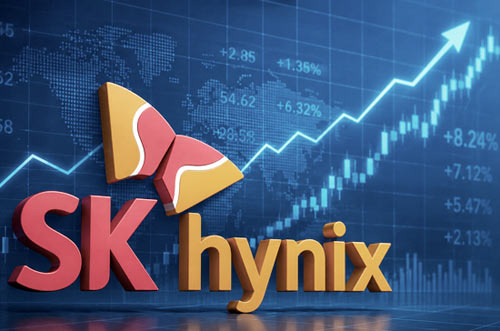
Are you aware that SK Hynix's Nasdaq listing news is currently a hot topic in the U.S.?
Looking at the scale, SK Hynix's U.S. ADS listing is being pursued at approximately $28 billion. It is said to be the largest ever for an Asian company on the U.S. stock market.
What's even more interesting is that long-term investment firms like Baillie Gifford, Coatue, and well-known hedge funds have expressed their intention to invest.
Why is there such intense interest?
Ultimately, it's because of AI.
The current competition in generative AI is essentially a GPU competition, and the GPU competition leads to a competition for HBM (high bandwidth memory).
No matter how advanced Nvidia's GPUs are, if HBM is not sufficiently supplied, AI servers cannot be completed.
The key supplier for that is SK Hynix.
In San Francisco, when meeting AI startups, almost everyone talks about securing GPUs.
However, the core memory that goes into those GPUs is led by SK Hynix in the global market.
This is why U.S. investors are paying attention to this company.
The purpose of this listing is not simply due to a lack of funds. SK Hynix already holds a massive amount of cash, and they plan to use the raised funds for the construction of the Yongin semiconductor cluster, the Cheongju advanced packaging plant, and the purchase of ASML's EUV lithography equipment.
At the same time, it also signifies a strong desire to be properly valued in the U.S. capital market.
Personally, I find the valuation aspect to be the most interesting.
Currently, SK Hynix has strong competitiveness in the AI memory market, but many analyses suggest it has been valued lower than its U.S. competitor Micron.
If it lists directly on the U.S. stock market, it will be easier for U.S. institutional investors to compare it against Micron on the same basis.
If the U.S. market grants a similar level of premium, the possibility of a reevaluation of corporate value is also being discussed.
However, it's not all rosy forecasts.
The first concern that arises is the issuance of new shares. Since this listing involves the issuance of some new shares, existing shareholders may see a slight dilution of their stakes.
Additionally, it's not guaranteed that it will be included in major indices like the Nasdaq 100 immediately after the U.S. listing.
Purchases by ETFs and index funds are likely to occur sequentially after a certain period.
Another concern is the AI industry itself.
While the current investment boom in AI continues, we cannot assume it will grow at the same pace forever.
If the investment speed in AI data centers slows down or HBM prices drop, the performance volatility of SK Hynix, which has a high memory ratio, could increase.
The recent global stock market's more cautious view on AI-related stocks is also due to this reason.
This ADR structure is also interesting.
SK Hynix has split one common share into ten ADR shares. If it were to list in the U.S. at the original share price, it would become an extremely high-priced stock exceeding $1,500.
By applying a 10-to-1 ratio, U.S. investors can trade at a price around $150, which is more familiar and accessible. This structure is much more familiar to individual investors in the U.S.
The atmosphere felt in San Francisco is also intriguing.
A few years ago, when discussing AI investments, most people only thought of Nvidia. But now, discussions also include HBM, packaging, power semiconductors, and data center cooling technologies.
The AI ecosystem has expanded significantly. In that sense, SK Hynix is beginning to be recognized not just as a memory company, but as a key player in building AI infrastructure.
Ultimately, this Nasdaq listing is not just an event of a single Korean company entering the U.S. stock market.
It is more like a test of how the U.S. capital market evaluates the key supply chain of the AI era.
If it successfully establishes itself, it could significantly influence the U.S. listings of other Asian tech companies in the future.
Therefore, I believe the reason Wall Street is looking at SK Hynix now is that it holds the essential infrastructure for the AI era.
 ShataForce
 OkElectronic
 WkndDeleted







 crystalo |
 Investment Beginner Company Information Encyclopedia |
 Always Dreaming of Big Success |
 happy 9 |
 coloradoman |
 DOCTOR MED |
 Reggae Party |
 Shining Our Own World |
 Breaking Bad Drama |
 Happy Together 213 |
  valtri |
  August Snowman |
  Way to easy |
  Pirate Ship Popcorn Maker |
  USA Business News |
  Samsung My My |
  bubblo |
  tartbear |
  Washington Monument |
  Forever Young |
  crystalx |
  Spaghetti Flying Religion |
  lunarpath |
  Another Eden Channel BLOG |
  sprinkletop |
  bongo |
  savannah choi |
  Successful Manager Kim's Team |
  Canvas Pro Blog |