

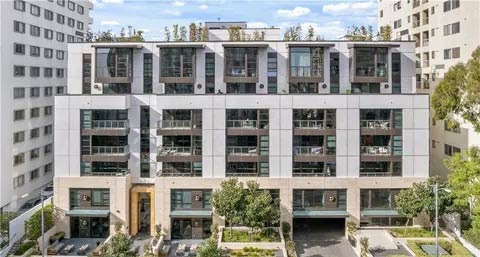
In January and February of this year, there were 1,976 condo transactions in LA County. This is the lowest since 2005, a 40% drop compared to five years ago.
The average transaction price in Koreatown is $690,000, with down payments ranging from $140,000 to $210,000. Even dual-income couples often fail to qualify despite income verification.
The real issue goes beyond this. It's not just the condo prices; it's the HOA fees that make people give up on condos.
In older Koreatown complexes, HOA fees typically range from $500 to $800 a month, with some exceeding $1,000.
When you add mortgage, property taxes, and HOA fees, the monthly burden is comparable to that of a single-family home. Then potential buyers say, "With this money, I might as well buy a house." It's hard to argue against that.
Why have prices risen so much? Half of the condos in LA are in older complexes that are 40 to 50 years old. Major capital expenditures like roof waterproofing, plumbing, and seismic retrofitting all hit at once.
Insurance premiums are 3 to 5 times higher than for similar-sized apartments due to California's condo regulations, which allow construction defect lawsuits for up to 10 years after completion.
No new constructions are being built, existing buildings are aging, and only HOA fees are increasing. It's a vicious cycle.
Is HOA Exploitation or a Necessary Evil?
My conclusion is, "It's a necessary evil, but if it continues to operate like this, it will truly become evil."
Without an HOA, common areas cannot be managed. However, many boards have not conducted proper reserve studies.
When a crisis hits, they charge special assessments of $20,000 to $50,000. At that moment, the property becomes ineligible for buyers.

So What Should Be Done?
Sellers should organize HOA documents first. Get the reserve study, meeting minutes from the last three years, insurance details, and any planned special assessments. What buyers fear most is not the price but "unknown bills." Starting with transparency can speed up negotiations.
Buyers should calculate HOA fees like a mortgage. A monthly HOA fee of $800 is equivalent to about $150,000 in mortgage payments at current interest rates. A $700,000 condo actually carries the burden of an $850,000 property. Choose complexes with money in their reserve accounts. That's a good HOA.
From a policy perspective, there needs to be a revision of the construction defect lawsuit law (SB 800). This is a major factor driving insurance premiums sky-high and preventing new constructions. We need to maintain consumer protection while finding a balance that doesn't kill the insurance market.
The fact that transactions have stalled means buyers have more negotiating power. Properties with price adjustments are starting to appear. The person who makes a decision when the market is quiet will ultimately win.
If you ask whether HOA is exploitation or a necessary evil, the answer is, "It becomes exploitation if you don't join the board and make changes."
If you own a condo, make sure to attend the next meeting. The future value of your asset could be at stake there.
 AcusWorld
 ArizonaZang
 LightAndPrio







 Premium Gas Camp |
 CA Real Estate |
 cheesepup |
 breezem |
 yentra |
 There Are Such Things in the World |
 Sunny's Travel in America |
 Study Abroad Life Know-How Tips |

 novapixel |
  Healthy Local Fresh Information |
  molten |
  Way to easy |
  intact |
  Always Dreaming of Big Success |
  happy 9 |
  Park M.Y. |
  tredon |
  Poppin News |
  metsoo |
  dewyo |
  Casa Mia |
  Asparagus Blog |
  dorange |
  hiddenkong |
  some fame |
  Godory Life |
  Lime Juice |
  French fries |
  Rynex |