

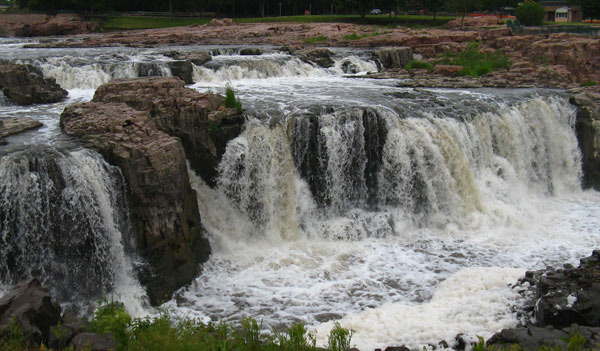
In Sioux Falls, the central city of South Dakota, there is 'Falls Park', which is the origin of the city's name.
This area is a waterfall region formed by the Big Sioux River flowing through the heart of the city, often referred to as the heart of Sioux Falls. First-time visitors are often surprised to find such natural scenery with waterfalls in the city.
The sight of the river cascading in multiple streams over the red granite rocks in the middle of the vast park is spectacular. The waterfall is about 30 feet high and over 100 feet wide, with the water volume changing with the seasons, creating different landscapes. In spring, the melting snow creates the most magnificent flow, while in summer, it is popular as a photo spot with its deep green hues.
This waterfall has been deeply connected to people's lives for a long time. Thousands of years ago, the indigenous Sioux tribe regarded this place as sacred, and in the mid-19th century, European settlers began to form the city.
At that time, mills and factories were built using the waterfall's drop, one of which is the remains of the 'Queen Bee Mill', which still exists today. This mill opened in 1881 but closed within a decade due to fire and financial difficulties.
Today, Falls Park has become more than just a park; it is a source of pride for the citizens of Sioux Falls and a representative tourist attraction.
The park features an observation deck where visitors can take an elevator to see the entire waterfall and the cityscape at a glance. The scene of water spray under the sky painted red at sunset is also loved by photography enthusiasts.
At the park entrance, there is a café called 'Falls Overlook Café', which is a renovated power plant building established in 1908, where visitors can enjoy a cup of coffee while gazing at the waterfall.
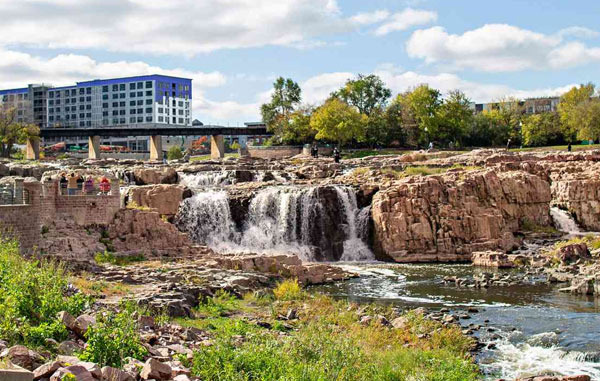
Falls Park is just a few minutes from downtown, making it easily accessible. Therefore, it is always bustling with office workers bringing lunch boxes, couples taking walks, and families riding bicycles every weekend.
Especially on weekends, tour buses line up, and sculptures by local artists are displayed around the park, adding a cultural touch. Notably, this park is not just about preserving the past; it is evolving into a sustainable urban space.
The city has been consistently working to protect the ecosystem around the waterfall and improve the water quality of the river. Trout and carp inhabit the waters, and migratory birds can often be seen resting here.
Ultimately, Falls Park symbolizes the past and present of the city of Sioux Falls, as well as the harmonious coexistence of nature and humanity. Amidst the sound of the massive waterfall, one can feel the history of the city, and as one walks through the mist carried by the wind, it becomes clear why this city is named 'Sioux Falls'.






 Dreams Come True as Desired |
 Dakota Man Blog Thanks |
 DREAM BIG |
  frostbite |
  330 Forever My Love |
  El Dorado |
  dralix58 |
  Gorama Round |
  Skydiving |
  dreamport |
  Yellow Snowman |
  Toaster Pizza Magic Show |
  velvetnom |
  Anytime Journey |
  Mrs. Duluth |
  jaxter |
  Atlanta Mama |
  Baguette Blog |
  Tan Sol |
  US Embassy |
  Korean Mom |
  My NYC |