

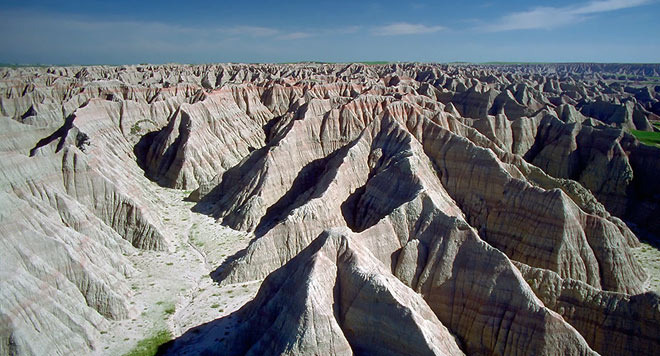
At the western edge of South Dakota, just beyond the Black Hills mountain range, a completely different landscape unfolds.
This is the area known as Badlands National Park, a seemingly endless expanse of eroded geological formations.
True to its name, 'Bad Lands' signifies a place that is difficult for humans to inhabit and where farming is nearly impossible. However, when you actually encounter this place, you feel an overwhelming grandeur unlike any other landscape.
The endless stretches of barren, yellowish-brown mountains, the layered rock formations sculpted by the wind, and the geological patterns etched over millions of years are all on display. It feels as if the ancient history of the Earth is laid bare.
This area was once an ocean about 70 million years ago. At that time, there was a shallow inland sea here, and the sediment that accumulated over it was eroded by time, wind, and rain, creating today's unique topography. The layers of soil and rock in various colors—red, yellow, gray, and white—look like a grand art gallery of nature.
In fact, geologists often refer to this place as 'the textbook of the Earth.' Each layer contains traces of life and environmental changes from tens of millions of years ago. Fossils of mammals from after the age of dinosaurs have also been discovered here, making it a world-renowned site for paleontological research.
However, the Badlands do not simply feel like a desolate rocky area. As you venture deeper into the park, it may appear desert-like at first, but there is an ecosystem where bison, pronghorns, and large hawks reside. In spring, wildflowers sway in the wind, and at sunset, when the sky is painted red, a strange sense of peace can be felt amidst the barrenness.
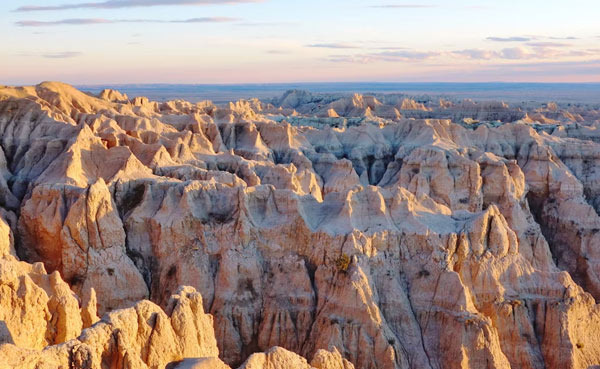
As you follow the roads of the Badlands, cliffs and canyons stretch endlessly. Among them, the 'Badlands Loop Road' is the most popular route, featuring several viewpoints along its approximately 40-mile stretch.
At the 'Big Badlands Overlook,' the vast rocky valley comes into view, and at the moment the morning sunlight hits, the color of the rocks turns red, creating a scene that looks as if it is on fire. Another attraction, 'Panorama Point,' offers a view of the Badlands stretching all the way to the horizon, just as its name suggests.
The weather in this region is extreme. In summer, temperatures can rise close to 40 degrees Celsius, while in winter, they can drop to minus 20 degrees. Therefore, visitors tend to come mostly in spring and fall. However, even in this extreme climate, wind and water continue to erode the land, creating new topographies. In other words, the Badlands are a living geological site that is changing even at this moment.
The night sky here is also special. With almost no city lights, thousands of stars seem to pour down as if they can be grasped. On summer nights, the Milky Way flows clearly, and if you're lucky, you might even see a meteor shower. Thus, the Badlands are also referred to as a 'holy land for stargazing' by astronomy enthusiasts.
Ultimately, this endless eroded geological rocky area in South Dakota serves as a pure history book of the Earth, untouched by human intervention, and a space where one can fully feel the time and power of nature. Few places make you feel the brevity of human time as intensely as this one.







 Dreams Come True as Desired |
 Dakota Man Blog Thanks |
 Korean Mom |
  My NYC |
  moo moo |
  Mr Oh |
  forevergee |
  festival |
  manchester |
  constant |
  Leapfrog Move |
  vibranto |
  Tora Tora |
  yellowbutter |
  Dolly |
  US Embassy |
  NYC saladbar |
  Finding Superfoods |
  lightyear |
  song bang |
  vexomo |
  Indiana Jones |