
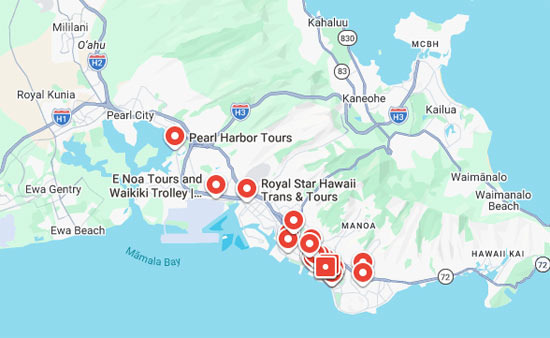
The saying that running a business targeting tourists in Hawaii is profitable is partly true and partly false.
Since I have a strong interest in starting a business or side hustle while working in Hawaii, I tend to look into various cases of tourism businesses in Hawaii.
On the surface, it looks really good. Hawaii attracts millions of tourists every year, and in January 2025 alone, visitor spending was about $1.89 billion, an increase from the previous year. Overall tourism spending in 2025 also continued to be substantial. It's natural to think, "Isn't it just a matter of taking a piece of this big pie?"
However, in Hawaii, you need to look at costs before revenue. As of 2026, the cost of living index in Hawaii is reported to be between 185 and 193, nearly double the national average of 100. Housing prices, rent, food costs, and labor costs are all high. Even hiring one employee is a burden, and rental prices near Waikiki or tourist areas are no exception.When business is good, you might think, "This is definitely Hawaii," but during the off-season, even if the number of customers decreases, rent and labor costs remain the same. The current economic trend is also peculiar. Tourists are not completely absent, but the atmosphere of everyone easily coming to Hawaii like before has weakened.
With rising accommodation and airfare costs, analyses suggest that middle-class family travelers are considering alternative destinations like Mexico or the Caribbean. Conversely, Hawaii seems to be attracting "fewer tourists who spend more." From a business perspective, it's essential to not just look at the number of customers but to accurately identify who the customer base is that can afford to buy my products.
Therefore, in my view, a low overhead, high margin model is much more advantageous in Hawaii. Opening a large store, stocking inventory, and employing multiple staff members is risky. Souvenir shops or offline retail stores face significant rent and inventory burdens and must compete with Amazon and online shopping.
On the other hand, models that generate income through personal services and experiences, such as photo tours, snorkeling guides, hiking guides, cooking classes, wedding and couple photography, and customized travel concierge services for Koreans, are relatively lighter.
Especially now, it's crucial to capture tourists digitally first. Google searches, Instagram, TikTok, blogs, booking pages, and review management essentially serve as the storefront sign for a business. Even without a physical location in Hawaii, if you can get tourists to book in advance before they depart, it becomes much more stable.
The conclusion is this: Hawaii's tourism business can be profitable. However, if you enter with the mindset that "it will definitely work just because it's Hawaii," you will be jolted awake during the off-season.
Hawaii is a market where both revenue and costs are significant. I believe that those who analyze the numbers first, reduce fixed costs, and capture customers online will survive.
 WheresMoney
 ToastPizzaMag
 GlamEditor







 mapsina |
 Mr. Largo |
 Victory 1988 |
 Infinite Style |
 novapixel |
 Unknown Dog Walk blog |
 cococo now |
 Duke Ducks |
  Hawaii Fox |
  Waiting for Godot |
  parlon |
  Say Yes in English |
  Sayonara H |
  rigid |
  Ohio Ohayoung Hello |
  U.S. Military Recruitment Information |
  You Turn Me On |
  DaeBak Electronics CNET |
  Anjollinya Blog |
  solid90 |
  elion |
  xylora |
  Study Abroad Life Know-How Tips |
  cheesepup |
  carpflow |
  Softy |
  breezem |