

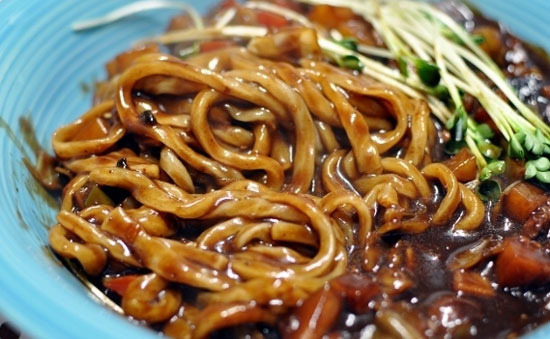
Since I was young, my family was poor,
we rarely dined out like others,
when my mother was at work,
I always cooked ramen alone at home.
Eventually, I got so tired of ramen
that I protested to eat something delicious.
Then my mother reluctantly took out
the hidden emergency fund to order
a bowl of jajangmyeon, and I was so happy.
But for some reason, my mother didn't eat it.
She said she didn't like jajangmyeon.
She said she didn't like jajangmyeon.
Living like that,
regretting and shedding tears.
In 2026, poverty in our era is no longer just about the hunger of not being able to eat a bowl of jajangmyeon.
If jajangmyeon in the late 90s symbolized the tears of a mother's sacrifice in a poor environment, nowadays I think this: as the world changes, shouldn't a bowl of jajangmyeon be something everyone can enjoy without a second thought, like water or air? Is that really such a difficult story?
If past poverty was literally about starvation, today's poverty in Korean society has transformed into a lack of opportunities and isolation in relationships.
For young people these days, jajangmyeon is not about the price. The moment of choosing the cheapest menu while staring at the delivery app screen, and the feeling of isolation of having to eat that food alone in a room, is the meaning of today's jajangmyeon. The economy is among the top in the world, yet the elderly poverty rate and suicide rate remain high, and self-employed individuals and platform workers live in a reality where they mortgage today for an uncertain tomorrow.
This is where the discussion of basic income comes in. The concept of providing all citizens with a minimum living expense unconditionally is no longer just a theoretical discussion. In an era where jobs are rapidly changing due to artificial intelligence and automation, basic income is being treated as a social infrastructure that supports survival. For basic income to become as natural as water and air in Korea, it must overcome several hurdles.
First, there needs to be a social consensus on how to secure funding. A structure must be created where the profits generated from new areas like carbon tax, data tax, and robot tax are shared by society as a whole. Currently, the digital economy concentrates profits in a very small number of companies, and if this structure is not adjusted, discussions about basic income will always hit a dead end.
Next is a change in the perception of labor. The old mindset of not eating if you don't work is already incompatible with a technological society. In an era where machines replace human labor, basic income should not be seen as money that encourages laziness, but rather as the lubricant that maintains consumption and the economy, and as a stabilizing device for society.
And finally, there is the standard of what is basic. Society must collectively define how far the minimum quality of life symbolized by a bowl of jajangmyeon extends. It is not merely about not starving, but about creating a line where everyone can live with dignity as members of society, which is the essence of basic income.
We have already briefly experienced that possibility. During the COVID-19 period, when disaster relief funds were distributed, many people said they felt relieved while ordering jajangmyeon with their families. It was also a moment when society as a whole felt that poverty is not an individual fault, but a structural issue.
Ultimately, when the day will come when we can eat jajangmyeon without a second thought depends on the choices our society makes. When the belief that humans have the right to live with dignity simply by being born translates into systems and budgets, that day will draw closer.
I hope that one day jajangmyeon will no longer be a symbol of tears, but just an ordinary dinner menu.



 Korean Mom |
 novapixel |
 Peter Pan Pet |
 horse |
 Sunset Oregon |
 Weekend Movie Blog |
 Beauty, Health, Lifestyle Blog |
 coloradoman |
 Superman Cat Blog |
 Atlanta Mama |
  Baguette Blog |
  US Embassy |
  My NYC |
  moo moo |
  Mr Oh |
  forevergee |
  festival |
  manchester |
  constant |
  Leapfrog Move |
  vibranto |
  Tora Tora |
  yellowbutter |
  Dolly |
  NYC saladbar |
  Finding Superfoods |
  lightyear |
  song bang |