

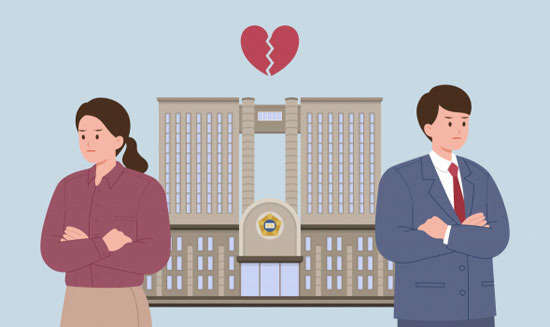
The Korean language can be frighteningly precise at times. Just by adding a dot to the character '님', it becomes '남'.
In a world where someone you vowed to be with for life can turn into a stranger with just one divorce stamp, the appearance of the characters already tells that truth.
Looking at couples around me, I see pairs that were once called lovebirds separating, while couples who used to fight all the time grow old together watching their grandchildren.
Why does the relationship of marriage endlessly oscillate between love and hate? From what I observe, people believe in a 'fateful connection' when they get married.
A soulmate, a lifelong partner. The problem is that the expectations of that fantasy hit the ceiling. If the expectation is 100 but reality is 80, the 20 difference accumulates into disappointment and resentment.
This is the reason why love and hate repeat. The greater the love, the greater the expectations, and the greater the expectations, the greater the sense of betrayal.
Hate is not the opposite of love; it is another name for unmet expectations.
If there is indifference, there is nothing to hate. To hate means there are still expectations left. Thus, love and hate are two sides of the same coin, and couples spend their lives flipping that coin.
Divorce is like that. It's not that the once-passionate love cools down, but rather the moment the balance of expectations drops into the negative. The person who was 'honey' yesterday becomes 'that person' today, and with one stamp, they become '남'. The time it takes to add that dot is one second, but the disappointment that builds up to that point takes years.Interestingly, the opposite also holds true. Two people who were complete '남' can meet and remove a dot to become '님'. Ultimately, marriage is a lifelong tug-of-war over that dot. Whether to add or remove it is a daily choice.
Living in America for a long time, I've noticed that the way of adding this dot varies by culture. Here, divorce is common and straightforward. Even after adding the dot, co-parenting is done coolly, and ex-spouses' families gather during holidays. In contrast, the Korean way often involves turning your back the moment the dot is added, becoming a stranger forever. It's not about which way is right; it's that even the way we withdraw expectations is a product of the culture we've learned.
So what should we do? The answer is simple. Lower the expectations at the starting line to match reality. Let go of the illusion that your spouse will fill all your deficiencies and the misconception that you will always feel excited. People don't change, and marriage is closer to a partnership than a romance.Paradoxically, couples who lower their expectations tend to last longer. When you don't expect much, a warm word feels grateful, and an ordinary dinner together becomes something to appreciate.
Disappointment ultimately arises from the gap between expectations and reality. The most certain way to close that gap is to adjust the expectations I can control rather than trying to change the other person whom I cannot control.
Let's avoid misunderstandings. Lowering expectations doesn't mean to stop loving. It means to see the person as they are, without illusions.If you expect a perfect spouse, you will be disappointed for life, but if you accept an imperfect human, peace can surprisingly come. Fate is not something predetermined; it is another way of saying that we make efforts every day to turn '남' into '님' by removing a dot.
The difference between '님' and '남' is just one dot. Whether we add or remove that dot is in our hands every day.
What expectations are you placing on your spouse today? Is that expectation so heavy that you are about to add a dot right now? It's worth pausing to ask yourself that question.
 RiverBlog
 TunaDance






 Peter Pan Pet |
 horse |
 Sunset Oregon |
 daisypat |
 Anjollinya Blog |
 Seattle - Emerald City |
 Bald Eagle Brothers |
 Bacon King Blog |
 PETRO Vatican Shrine |
 Real Estate Agent USA |
  draxen |
  gallery |
  milkyotter |
  Zoom Zoom Zoom |
  Minnesota Lakes and Clouds |
  noraro |
  tervox95 |
  vale vale |
  yentra |
  Golden life |
  andrew park |
  Balan |
  Cali M Law Group |
  neroyo |
  Dreams Come True as Desired |
  Khan Film Blog Production |
  coloradoman |
  Living Economy Information Blog |
  rustley |