
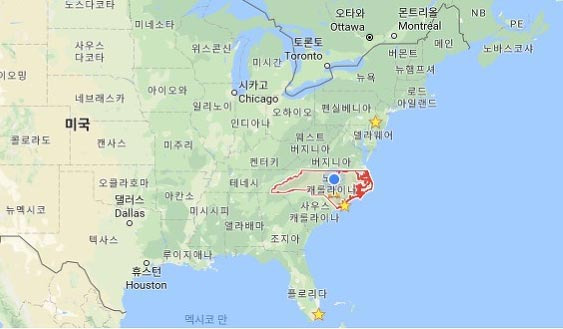
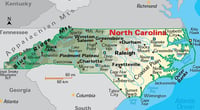
Raleigh, the capital of North Carolina, is one of the fastest growing economic centers in the southeastern United States.
The true strength of this city lies in its 'industrial diversity' and 'knowledge-based economy.' It is not just a place where factories or headquarters are clustered, but a structure where universities, research institutes, startups, and large corporations are naturally connected. This is the heart of the famous 'Research Triangle.'
Prestigious universities such as NC State University, Duke University, and UNC Chapel Hill are located here, and thanks to the talent pool and research capabilities generated by these three schools, companies have flocked to the area. Until the 1950s, this region was a quiet, agriculture-centered state, but it completely changed after the 1960s with the establishment of high-tech industrial complexes. Now, global companies like IBM, Cisco, Lenovo, and Red Hat all have research centers nearby.
The top industry supporting Raleigh's economy is technology and research and development. Fields such as biotechnology, software, artificial intelligence, semiconductors, and energy technology are particularly strong. The North Carolina state government has implemented business-friendly tax policies, creating an environment where not only large corporations but also startups can thrive. As a result, job growth is rapid, and average wages are steadily increasing.
The second major pillar is education and healthcare. With many talents produced by state universities, Duke, and UNC, the medical technology, pharmaceuticals, and healthcare industries have developed. Duke Medical Center and UNC Health System are nationally recognized for their high standards, and related venture companies have gathered around, naturally forming a medical cluster. In simple terms, it can be said that Raleigh is a city that demonstrates the model of 'a city that excels in education also earns well.'
Raleigh is also consistently ranked among the most livable cities in the United States. One reason for this is its 'balanced economic structure.' With IT, education, healthcare, finance, manufacturing, and the public sector evenly distributed, the city does not become unstable even if one sector falters. For example, during the 2008 financial crisis, while New York and San Francisco were severely impacted, Raleigh recovered relatively quickly.
The cost of living and housing has also been a significant advantage. You could find good homes for less than half the price of those in San Francisco or New York. Of course, in recent years, housing prices have risen significantly, making it difficult to say it is still cheap, but the ratio of housing costs to income remains reasonable. For this reason, young professionals, tech workers, and families are flocking to the area.
NC State University also plays a significant role in the industrial growth of Raleigh. The school is known for engineering, IT, agricultural technology, and energy research, and its 'Centennial Campus' is essentially a mini industrial complex. Private company research centers are located next to faculty research labs, and students gain field experience by participating in actual corporate projects before graduation. In this way, the university and companies form a single ecosystem.
Of course, rapid growth has its shadows. There are concerns that traffic congestion is worsening and that the pace of population influx is outpacing the city's infrastructure. However, it remains unchanged that Raleigh is the "most intellectually wealthy" city in the southeastern United States.
In summary, Raleigh is a successful example of a city that has evolved from an agricultural town to a technology and research-centered city. Instead of factories, it has research institutes, and instead of labor, it has grown its economy through knowledge. Contrary to the traditional image of the southern United States, Raleigh is a quiet yet smartly profitable city.





 NC Dreamer |
 Balan |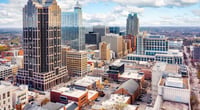
 Audio Mania World |
 North Carolina State University |
  Anytime Journey |
  Mrs. Duluth |
  jaxter |
  Atlanta Mama |
  Baguette Blog |
  US Embassy |
  Korean Mom |
  My NYC |
  moo moo |
  Mr Oh |
  forevergee |
  festival |
  manchester |
  constant |
  Leapfrog Move |
  vibranto |
  Tora Tora |
  yellowbutter |
  Dolly |
  NYC saladbar |