

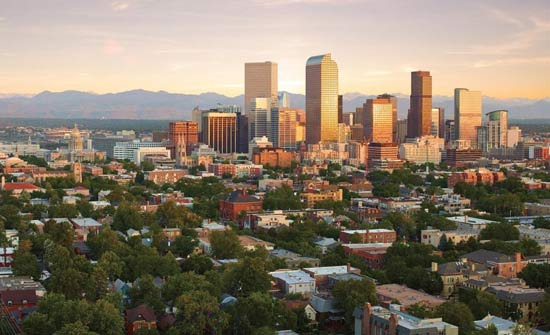
When I first spent winter in Denver, I felt it had a quite different atmosphere from the image of the 'green city of the Rockies' in advertisements.
Being a city located about a mile (1609m) above sea level, the air is clear and the sky is transparent, but when you look at the ground, the reddish earth or yellowish brown catches your eye first. The trees have almost shed their leaves, and a unique desolate stillness between late autumn and early winter settles over the city.
I thought to myself, "Is this really Denver?" The gray city at the edge of the plains, with the Rocky Mountains standing like a wall behind it, and the road in front stretching endlessly toward the horizon, had a strangely similar vibe to the desert landscapes of New Mexico and Nevada.
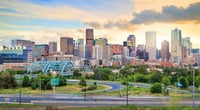
However, the interesting thing is that as soon as you pick up a camera, Denver can instantly cosplay as a 'green city.' If you just tilt the angle slightly upward, the barren land disappears off-screen, leaving only the Colorado Blue Sky.
The sky in Denver is particularly blue and deep, so in photos, it can look like an eco-friendly city with endless parks. The air is dry and the humidity is low, making the sunlight sharper, which enhances the saturation of the sky color to an unbelievable level.
Even without filters, taking a wide-angle shot can bring out such vividness that it could explode with likes on social media. Locals joke that "Denver has yellowish ground and such a beautiful sky that the camera deceives the city."
On a day when I was strolling through downtown Denver in November, the contrast between the leaves scattered on the ground, the dust blown by the wind, and the blue sky shining proudly was strangely beautiful. One shot was barren and winter-like, while another was refreshing and vibrant... it felt like two different cities could be created just by turning the camera in the same spot.
People taking photos in Denver usually make good use of this point. Capturing the ground or the outskirts of the city gives a nuance like the western desert, while framing upwards towards the trees and sky reveals a postcard-like blue. Should we say that documentary photos represent reality, while social media photos represent fantasy?
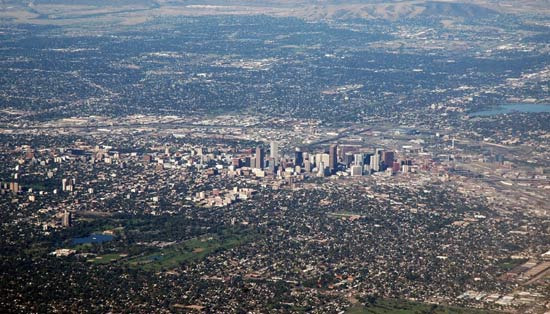
Especially when taking pictures in front of Union Station near downtown, the colors change in a very subtle way.
If you only capture the buildings, it has a classic city vibe, but when you widen the angle, the blue sky gives a sense of openness, and if you capture the ground, the yellowish earth looks like a desert. When you turn the lens towards the Rocky Mountains, the plains, clouds, and mountain range come into one frame, making you think, "This is real Colorado," but when you look at just the ground, you might wonder, "Wait? This looks like New Mexico?"
In November, Denver has no flowers and the trees are bare, but that makes the city's dry beauty stand out even more.
The rough wind, gently sloped hills, and the wide-open sky make the city feel smaller and the people seem like dots, and I liked that simplicity. And while taking photos, I realized that Denver may seem barren at first, but in reality, it is a city that shows different expressions in every photo.
In summer, the grass and trees turn green, showcasing the tourist image, but in late autumn and early winter, that shell peels away, revealing the true colors of the landscape. Barren does not equal bland; rather, it is a season where the sky, wind, and people become clearer because of the emptiness.
In conclusion, Denver is a city placed on earthy ground, but if you just lift the camera up, it becomes the bluest city in the world.
That twist seems to be the charm of this city. November in Denver is a season where barrenness and freshness coexist. When you look up at the sky with a hot cup of coffee in hand at the end of a chilly alley, that blue often covers all the barrenness.
So I often say with a smile.
"Denver looks like a desert in reality, but in photos, it's an Instagram-worthy city."




 moo moo |
 ultron78 |
 garlic bread |
 Sugar Cream Door Bulletproof Noodles |
 urbanmint |
 Your Curiosity Resolved |
 LIZ Legal Information Blog |

 Nuchuhan Exploration BLOG |
  Burbank Lee |
  Olivia's Blog |
  Bushing Around Life |
  Active |
  Cherokee Rose |
  Kor. Master |
  Holey Moley |
  Conflite Teacher |
  Hodong Prince Over Flex |
  Mist inn |
  citrus pop |
  Onion Ring |
  phoenixia |
  viewtop |
  loverun |
  Kim Do Sun |
  SEVEN SEVEN |
  yentra |
  Make My Day |
  Victory 1988 |