

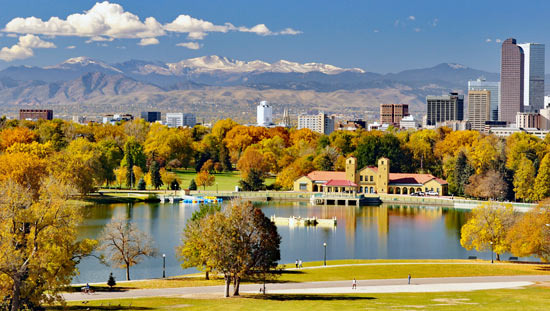
When visiting Denver for the first time or planning a move, the first piece of information you typically seek is the 'weather.' While many might picture Colorado as a winter wonderland with snow year-round, this is merely an illusion created by the massive Rocky Mountains. In reality, the weather in downtown Denver is much warmer, drier, and, above all, brilliantly clear. As the 'Mile High City,' located at an elevation of 1,609 meters (5,280 feet), Denver's unique and attractive four-season climate is thoroughly analyzed here.
Key Words of Denver's Climate: '300 Days of Sunshine' and 'Semi-Aridity'
The number that best describes Denver's weather is '300.' Denver boasts about 300 days of sunshine each year, making it one of the cities in the U.S. with the highest amount of sunlight. The fact that it has more clear days than coastal resorts like Miami or San Diego often surprises newcomers.
The source of this climate is the high altitude and the geographical barrier created by the Rocky Mountains, resulting in a semi-arid climate. The average annual precipitation is about 14.3 inches (approximately 363 millimeters), which is quite low. Due to the low humidity, summers are free from the sticky sweat typical in other regions, and winters are less harsh with biting cold winds. The advantage of low humidity means that even on hot days, you can quickly feel cool in the shade, and on colder days, standing in the sun can quickly warm you up.
Highlight Season: Summer (June - August)
Summer in Denver is a paradise for outdoor enthusiasts. The average high temperature in July reaches 88-90°F (31-32°C) and can often exceed 100°F (38°C). However, thanks to the previously mentioned low humidity, the heat feels much more pleasant compared to summers in the eastern U.S. or Korea.
In the summer afternoons, an interesting natural phenomenon occurs. Locals refer to it as the 'Afternoon Storm,' which brings brief but intense thunderstorms. These storms are a welcome relief from the summer heat, but they can pour down heavily enough to account for most of the precipitation. Typically, the skies clear up within 1-2 hours, so it's wise to plan outdoor activities like hiking or golfing in the morning.
Milder Winter Than Expected (December - February)
Many people mistakenly believe that winters in Denver are harsh, but in reality, the winter in the city is quite mild. The average low temperature in January hovers around 16-18°F (-8 to -9°C), while the daytime highs remain in the 40s°F (about 4-7°C). The strong sunlight often makes a heavy coat feel cumbersome during the day.
The greatest blessing of Denver's winter is the 'Chinook' winds. These warm, compressional winds that descend from the Rocky Mountains can raise the temperature in the frozen city by dozens of degrees in just a few hours. This is why you can see locals jogging in short sleeves the day after a heavy snowfall that left snow up to their knees.
Unpredictable Spring (March - May) and Golden Autumn (September - October)
Spring and autumn in Denver are starkly contrasting seasons. Spring is the most unpredictable and variable season in Denver. Surprisingly, the months with the most snowfall in downtown Denver are not in winter but in March and April. As temperatures warm up, sudden blizzard warnings can occur, making spring snow common; thus, it's essential to keep a scraper and light padding in your vehicle during this time.
In contrast, autumn is the most peaceful and beautiful time of the year. By September and October, the oppressive summer heat recedes, and cool, pleasant breezes begin to blow. The highlight of Denver's weather during this time is undoubtedly the Aspen trees in the Rocky Mountains. As the mountain ridges begin to turn golden, the city comes alive with people eager to drive and hike on weekends. Unlike the unpredictable spring, autumn tends to have relatively stable clear weather, making it one of the best seasons to move.
As a tip for settling in Denver, it's important to note that this city can experience all four seasons in a single day.
In the morning, you might need a light jacket, but by lunchtime, you could be wearing a short-sleeve shirt due to the significant temperature fluctuations. Layering thin clothing is essential to adapt to these temperature changes. Additionally, due to the high altitude and many sunny days, sunscreen, sunglasses, and moisturizers or lip balm are must-haves in your bag year-round.
In summary, Denver's weather can be described as "unpredictable but generally very clear and pleasant." The diverse and ever-changing climate, along with the ability to enjoy outdoor activities under clean skies throughout the year, explains why Denver consistently ranks among the top cities Americans want to live in.
 sunset90
 mooncitywalker2017
 OrangeCmdr
 SkyFoxMan
 NebraSanta




 Victory 1988 |
 Smile Face |
 Helpful Life Stories |
 Casa Mia |
 Study Abroad Life Know-How Tips |
  Your Curiosity Resolved |
 self-evaluation |
 Colorado Love |
 SWAT TEAM BLK |
 LIZ Legal Information Blog |
  valtri |
  August Snowman |
  Way to easy |
  Pirate Ship Popcorn Maker |
  USA Business News |
  Samsung My My |
  bubblo |
  tartbear |
  Washington Monument |
  Forever Young |
  crystalx |
  Spaghetti Flying Religion |
  lunarpath |
  Another Eden Channel BLOG |
  bongo |
  savannah choi |
  Successful Manager Kim's Team |
  crystalo |
  Canvas Pro Blog |