

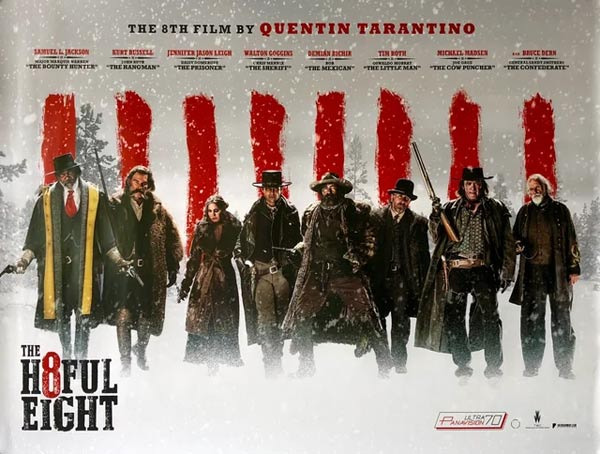
Surprisingly, among those who say they like Tarantino films, not many have actually watched The Hateful Eight (2015) all the way through.
People often talk about Pulp Fiction or Kill Bill, but when The Hateful Eight comes up, they tend to say, "Wasn't that a bit long?" or "I haven't heard of that movie."
In fact, this film is not really focused on entertainment. It feels more like a work where Tarantino has abandoned the idea of catering to the audience.
For nearly three hours, it relentlessly explores the process of humans suspecting, testing, lying to, and killing each other inside a cabin during a snowstorm.
Strangely, after that long duration, what lingers in your mind is not the gunfights but the cold air and damp tension.
The setting is post-American Civil War Wyoming, but the actual filming took place in the mountainous areas around Telluride, Colorado. What's important here is not just the "pretty snowy scenery." Tarantino, who usually stylishly wraps up human hatred, pushes it even more harshly with the snow-covered mountains in this film.
The winter landscape of Telluride is more brutal than beautiful. It is endlessly white but lacks any warmth.
When you see the snow-covered mountains, you might typically think of liberation or romance, but the snowy scenery in The Hateful Eight instead evokes the thought, "If I get lost there, I would just die." This perfectly matches the film's atmosphere.
The Kia Telluride we know takes its name from the Telluride in Colorado, which is the backdrop of this film.
The strategy was to emphasize that it is an SUV inspired by the rugged Rocky Mountains and the image of upscale ski resorts.
In reality, Telluride is famous as a preferred winter vacation spot.
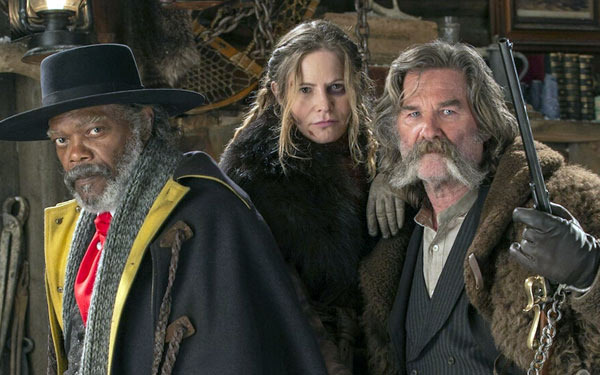
And when discussing this film, one cannot overlook the 70mm Ultra Panavision filming.
Those who know a bit about films often add that it should be watched in the "roadshow version." This is not incorrect. The problem is that many people boast about the format rather than the film's content. Of course, the Colorado snowfields shot in 70mm are overwhelming.
The screen feels so vast that it can even feel cold. But the funny thing is that with such a wide screen, the characters are ultimately stuck inside a shabby cabin, cursing and bleeding at each other.
Tarantino intentionally contrasts this. Outside, it is grand and majestic like the myth of the Wild West, but inside, the humans are ugly and pathetic. This film is closer to the cynicism that "America was originally a place that started with mutual hatred" than a traditional western.
Samuel L. Jackson shows an almost monstrous presence here. Kurt Russell symbolizes aged and weary violence, while Jennifer Jason Leigh is disturbingly intense.
Unlike recent Hollywood films, the characters are not neatly packaged. They are all vile, dirty, and untrustworthy. It's unclear who is righteous. Tarantino has a knack for making violence feel humorous, but in The Hateful Eight, it can suddenly make you feel dirty. This was likely intentional.
We cannot overlook Ennio Morricone's music. In fact, Tarantino has a strong image of using existing music well, but here he has provided a proper original score. However, even the music feels more unsettling than beautiful. Listening to it gives you the feeling that "something is about to go wrong." Ultimately, it won the Academy Award for Best Original Score, but this music also serves to make the film feel more ominous rather than comfortable.
That's The Hateful Eight. It's stylish yet unpleasant, long and slow yet strangely compelling, and when it's over, it leaves you with a cynicism about human nature rather than a sense of relief.
If you have the time, I recommend watching it. Saying you like this film can give the impression that you know your movies.
However, I found that not many people who watched it all the way through actually liked it.
 SoulWalker
 OmingOming
 GapdolFlex






 Ham and Cheese |
 oflare |
 Vacation on Hawaii |
 RV Samuel's Dad |
 4 Runner x100 |
 Your Curiosity Resolved |
 Jean Claude Bundang Blog |
 Univ Student |
 LIZ Legal Information Blog |
 Runner Kim |
  Lifestyle Information Search USA |
  Study Abroad Life Know-How Tips |
  denvik37 |
  Living Economy Information Blog |
  yenne |
  Kor. Master |
  FLORIDA Acus |
  Seattle - Emerald City |
  Rice Shop Uncle BLOG |
  My Love DS |
  Cali M Law Group |
  Agenda Center |
  My Town My Way Blog |
  US Legal Consultation on Trials |
  Hawaii Tourist Information |
  Texas Migration Story |
  Yellow Snowman |
  ultron78 |