

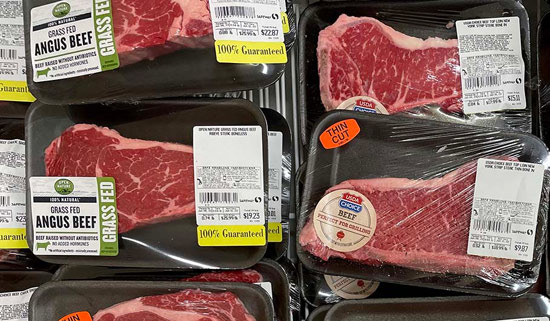
These days, when I go grocery shopping, I can't help but feel shocked by the price of beef.
Honestly, beef was never cheap, but recently it has skyrocketed to prices that feel as high as gold.
I've lost count of how many times I've picked up a pack of New York steak or ribeye at the market, only to put it back after seeing the price tag. In the past, if I wanted to have a barbecue party with friends on the weekend, I could buy plenty to grill, but now just thinking about swiping my card at the checkout makes my heart sink.
Living in Santa Monica, I'm used to high prices, but it feels like beef prices have risen particularly steeply in the last few months. When I think about why it has become so expensive, it seems there are several overlapping reasons.
The first is the supply issue. As often reported in the news, droughts in the Midwest are worsening, and feed prices are rising, causing ranchers to raise fewer cattle than before. The main ingredients for feed are corn and soybeans, and with climate change and rising international grain prices, the costs have skyrocketed, naturally increasing the cost of raising cattle. Additionally, labor costs have continued to rise since the pandemic, so the costs throughout the entire process from farming to slaughtering to distribution are directly reflected in consumer prices. Thus, by the time it hits the shelves at the Santa Monica market, it has already doubled in price.
The second factor is logistics and energy costs. Santa Monica is a coastal city with a well-established fresh food supply chain, but ultimately, it has to follow the transportation network that goes throughout LA. However, with truck transportation costs and fuel prices not being what they used to be, it naturally affects meat prices. Especially for beef that needs to be transported refrigerated or frozen, energy costs hit hard. All of this leads to a greater burden on consumers, making the perceived cost of living even higher.
The third reason is demand. Ironically, even as beef prices rise, many people still seek it out. In areas like Santa Monica, where health and wellness are prioritized, there is a tendency to consistently consume beef as a source of protein. While there are alternatives like plant-based patties, tofu, and chicken, you can't just serve tofu steaks when gathering friends for a barbecue near the beach on a weekend evening. Therefore, demand doesn't easily decrease, resulting in a vicious cycle where prices can't drop.
I initially thought the rise in beef prices was just temporary. However, as it has maintained a consistently high level this year, I've found myself changing my consumption patterns.
In the past, I would grill steak at home two or three times a month, but now it's down to about once a month, and even then, I only buy it on sale and try to make it last.
Instead, I've been relying more on chicken, salmon, and sometimes veggie burgers for my meals.
It seems like the Santa Monica market is cleverly taking advantage of this situation.
When terms like prime cut, organic label, and grass-fed are attached, the prices go up significantly, yet consumers think, "Sure, let's spend a little more for health," and buy it. However, honestly, these days, even with these labels, the prices have risen so excessively that it feels more like a brand premium than a genuine health consideration.
Opening the window in my beachside home and smelling the beef grilling in the evening while enjoying a glass of wine with family used to be the romance of living in Santa Monica, but now those moments are becoming increasingly rare. Of course, I can still enjoy it, but it's not as easy to say, "Let's just grill steak today" like it used to be.
What will happen in the future? Experts say that the number of cattle raised needs to increase again for prices to stabilize, but considering the climate and feed issues, it seems unlikely to be resolved in the short term.
Moreover, with inflation pressures still high across the U.S., I suspect beef prices will remain elevated for the foreseeable future.
As a Santa Monica resident, I feel like I will ultimately have to narrow my choices. This means reducing beef consumption and looking for other sources of protein.
Now, every time I see the beef display at the market, I can't help but think, "Is this real meat, or is it a luxury item?"






 U.S. Weather Bureau News |
 Conflite Teacher |
 Exploring American Life Information |
 Soy Angelino |
  laro90 |
  MEDBIO American Doctor Blog |
  SWAT TEAM BLK |
  DREAM BIG |
  frostbite |
  330 Forever My Love |
  El Dorado |
  dralix58 |
  Gorama Round |
  Skydiving |
  dreamport |
  Yellow Snowman |
  Toaster Pizza Magic Show |
  velvetnom |
  Anytime Journey |
  Mrs. Duluth |
  jaxter |
  Atlanta Mama |
  Baguette Blog |
  Tan Sol |