

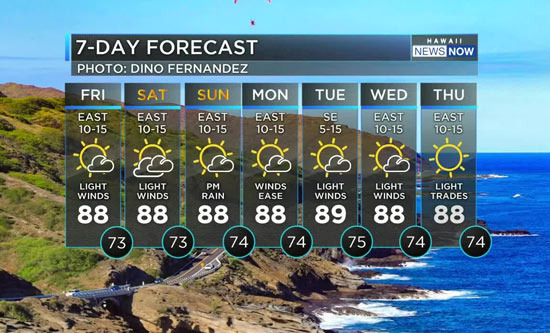
When talking about the weather in Hawaii, many people are surprised by one fact: it's "not as hot as you might think."
Those who have moved to Hawaii are often astonished that, despite being a tropical island, it never reaches 100 degrees like Texas does.
In reality, Hawaii's climate experiences very little temperature variation throughout the year, thanks to being surrounded by the Pacific Ocean. The average daytime temperature in summer is about 85 degrees, while in winter it's around 78 degrees. The temperature differences between seasons are also minimal.
Specifically, the highest recorded temperature in Honolulu is 95 degrees, and most days maintain temperatures in the upper 70s to mid-80s.
Interestingly, Hawaii and Alaska hold the record for the lowest maximum temperatures among the 50 states in the U.S.
Both states have an official record high of 100 degrees, with Hawaii's highest temperature recorded at 100 degrees in 1931 in Pahala on the Big Island, and Alaska also reaching exactly 100 degrees.
The reason this phenomenon occurs is due to the ocean. Hawaii is surrounded by the Pacific, which prevents hot or cold air from lingering for long. The National Weather Service describes Hawaii's climate as a prime example of a maritime climate strongly influenced by the ocean.
Another important factor is the trade winds. The winds blowing from the northeast cool the entire island, so even though the sun is strong, many days feel relatively comfortable. Therefore, even at 85 degrees, it feels quite different from the heat experienced in Texas or Florida.
Of course, it's not true that it never rains in Hawaii. In fact, there are significant weather differences even within the islands.
The southern coast, where Waikiki and Honolulu are located, is relatively dry, while areas like Kaneohe and Kailua, which face the wind first, receive rain much more frequently. It's common to see one side clear while the other side experiences a downpour, even with just a 20-30 minute drive.
The same goes for winter. While short sleeves are natural along the coast, snow falls on the summit of Mauna Kea on the Big Island. This means that within the same state, there are people surfing while others are enjoying the snow at the same time.
The biggest charm of Hawaii is that it rarely experiences extreme weather. There are no scorching heat waves like in Texas, no bitter cold like in the Midwest, and snowstorms are rare in the East. Many residents jokingly say, "The biggest tourist attraction in Hawaii is the weather."
Living here, you realize that this statement is not an exaggeration.
While living in Hawaii, people often say, "You can wear shorts and short sleeves all year round," and when you actually experience it, you realize it's not just a tall tale.
 Castle99
 traveler87
 SunnyForest74







 ollege Mom |
 Helpful Life Stories |
 prixon74 |
 Balancework |
 Make My Day |
 HAWAII Korean Church News |
 Hawaii Tourist Information |


 Unknown Dog Walk blog |
  urban legend |
  coolriver |
  Good Neighborhood, Wealthy District Information |
  Ro Ro Car |
  Amber H |
  new sugar |
  Palm 1000 |
  loran |
  donutfield |
  Tennis City |
  sunny7 |
  Questions about firearms while living in America |
  Shoot Me |
  mochifox |
  zucchini |
  Anna Life |
  Exciting FM Radio |
  pet dog |
  toodin |
  rosed |