
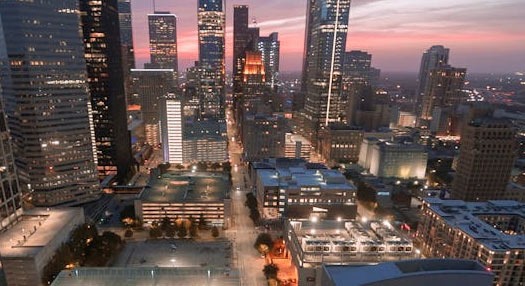
Houston has developed economically as a port city since the late 19th century and grew rapidly with the oil boom in Texas in the early 20th century. In this process, it emerged as the largest city in Texas, surpassing New Orleans, Louisiana. The development of the oil and energy industries significantly impacted Houston's economy, and with the city's growth, a strong image of a oil industry city was formed.
The city of Houston was named in honor of Sam Houston, a general and hero of the Texas War of Independence, who was the first president of the Republic of Texas and later served as governor after Texas was annexed by the United States. The naming of the city as Houston carries historical significance.
Houston is considered one of the cities with particularly severe urban sprawl, which is evident in the city's low population density and the wide spread of residential areas into suburban regions. The city covers a very large area, and while a large commercial and business district is formed around downtown, other areas are spread out as low-density residential neighborhoods. Thanks to this vast urban area, it has a city structure similar to Los Angeles (LA) and has developed as a city centered around private vehicles rather than public transportation.
Although Houston's urban history is relatively short, its true urban heyday began in the 1960s during the automobile boom.
During this period, infrastructure centered around automobiles developed, and the rapid increase in private vehicle use allowed Houston to grow even faster. However, this led to the formation of a car-centric city rather than a pedestrian-friendly city or a public transportation-centered city, which has had a significant impact on Houston's transportation system and urban planning today.
Houston is well known as a city convenient for traveling by car, but this aspect is also a reason for urban engineering criticism. It faces similar issues as high-density cities like LA, and the lack of public transportation and shortage of pedestrian-friendly urban spaces remain challenges to be addressed.
Houston is a city that well demonstrates its characteristics as a center of the oil and energy industry, large urban area, and car-centric city.
Downtown Houston has a grid layout that allows for relatively easy traffic flow, and high-rise buildings are mainly concentrated in downtown. Located about 10km west of downtown is Uptown Houston, which features 64-story skyscrapers like the Williams Tower, making it visible from afar, and it is also famous for the Galleria shopping mall. In a city like Houston, where sprawl is severe, Uptown is uniquely an area with high-rise buildings, forming a commercial district despite a high proportion of residential areas.
Koreatown is located slightly west of downtown Houston, with a concentration of Korean residents in the left area bordering Uptown. The Korean population is widely distributed, with about 40,000 people, making it difficult to designate a specific area as Koreatown. However, in the western part of Houston, there are many commercial facilities such as H Mart, beauty salons, restaurants, and Korean hospitals, indicating a well-established Korean business district. Additionally, further west in Houston is a satellite city called Katy, which has an even more overwhelming Korean population, making it a region that could be called Koreatown.




 moo moo |
 ultron78 |
 garlic bread |
 Sugar Cream Door Bulletproof Noodles |
 urbanmint |
 U.S. Weather Bureau News |
 Things to know |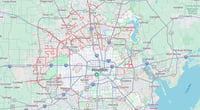
 Premium Gas Camp |
  Texas Real Estate Blog |
 action blog 101 |
  US Embassy |
  Korean Mom |
  My NYC |
  Mr Oh |
  forevergee |
  festival |
  manchester |
  constant |
  Leapfrog Move |
  vibranto |
  Tora Tora |
  yellowbutter |
  Dolly |
  NYC saladbar |
  Finding Superfoods |
  lightyear |
  song bang |
  vexomo |
  Indiana Jones |