

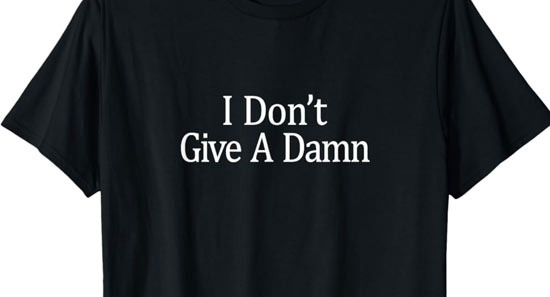
When watching American movies or dramas, you often hear the phrase
"I don't give a damn."
If you live in America, the words themselves are not difficult.
However, the meaning can be a bit confusing at first.
If you translate it literally, it becomes a strange sentence like "I don't give a damn (something) at all."
In reality, the meaning of this expression is quite different. Simply put, "I don't give a damn" means "I don't care at all."
It is used to express a lack of interest in a situation, opinion, or someone's words.
In Korean, it can be translated to something like "알빠노," "알 바 아니다," or "I don't care."
For example, if someone asks, "Don't you care about what people are saying about you?" you could respond with:
"I don't give a damn."
This means "I don't care about that at all."
It can convey strong emotions or simply express indifference.
The key word in this expression is "damn."
While it sounds common now, this word has quite a long history.
Originally, the word "damn" started with a religious connotation.
In Middle English, "damn" had strong meanings like "to be cursed" or "to fall into hell."
Therefore, in the past, it was considered quite a severe curse.
Over time, the intensity of this word has diminished.
In modern American English, it is not treated as a very strong curse.
Instead, it is often used as a somewhat rough emphasis.
Thus, the expression "I don't give a damn" is historically quite old. It appears in 19th-century literary works and old films.
There is also a famous scene that popularized this phrase. In an old Hollywood movie, the line "Frankly, my dear, I don't give a damn" was spoken, and at the time, this expression was considered quite strong and became a topic of discussion. By today's standards, it seems relatively mild, but at that time, it was a phrase difficult to use on air.
So, is it okay to use this expression in everyday life?
To conclude, it depends on the situation.
When talking casually with friends, it is generally not a big deal. Especially in America, this expression is often used just as an emotional emphasis. Therefore, it appears quite naturally in movies and dramas.
However, it is not advisable to use it in front of someone you just met or in formal settings.
In situations like work meetings, school presentations, or business conversations, this expression can sound somewhat rude. It may give the impression that you are dismissing the other person's opinion.
For example, if someone is speaking seriously and you say, "I don't give a damn," it can come across as an aggressive way of saying, "I don't care about what you said at all." So in such situations, using expressions like "I don't really care" is much softer.
What about children using this expression?
In America, opinions on this matter are somewhat divided.
Some families do not see "damn" as a big issue. However, many parents do not like their children using such expressions. Especially in school, it can be seen as impolite.
Therefore, young students are often taught to use expressions like "I don't care." While it has the same meaning, it sounds much softer and more polite.
Interestingly, there are various ways to express the meaning of "not caring" in English.
"I don't care" is the most basic expression, and there is also the phrase "I couldn't care less."
Looking at this, language is not just about knowing the meanings of words. It is also important to understand in what situations they are used, who uses them, and how the other person perceives them.
Thus, as you learn English, you naturally come to realize these facts. Expressions that do not appear in textbooks often come up in real life.
The phrase "I don't give a damn" is no exception.
While it means "I don't care," it also carries the history of an old English expression and the American style of conversation.
 HawaiiTofu







 ollege Mom |
 Helpful Life Stories |
 prixon74 |
 Balancework |
 Make My Day |
 Learn English Accurately |
 Egg Steamed Pot |

 U.S. Supreme Court Judge Kim |
  vanilla |
  norvexi |
  Lunch and Dinner Mexican Taco |
  skykong |
  My Circle |
  novapixel |
  urban legend |
  coolriver |
  Good Neighborhood, Wealthy District Information |
  Ro Ro Car |
  Amber H |
  new sugar |
  Palm 1000 |
  loran |
  donutfield |
  Tennis City |
  sunny7 |
  Questions about firearms while living in America |
  Shoot Me |
  mochifox |