

The first time I heard the name Kwon Yi-joo was in a marathon community.
I was busy preparing for the LA Marathon, and a member shared a link saying, "There is a Korean who crossed America by running at the age of 65."
At first, I thought, "No way..." I thought I had run quite a bit, but the idea of running across the entire continent of America sounded like fake news.
Sitting in a car and driving from LA to New York is already a tough task that one might do only once in a lifetime, so how could someone have run that long distance?
However, it was a fact reported by numerous American media outlets. He didn't walk, nor did he just ride in a car. He crossed America solely on foot, running an average of 50-60 km each day.
>> View New York Times article
In 2010, at the age of 65, Mr. Kwon Yi-joo ran a staggering 5,600 km from Los Angeles to New York. The reason he decided to cross America was that he had suffered from diabetes complications to the point of being unable to walk and losing all his teeth, but through his indomitable will, he healed his diabetes by running and aimed to become a diabetes ambassador.
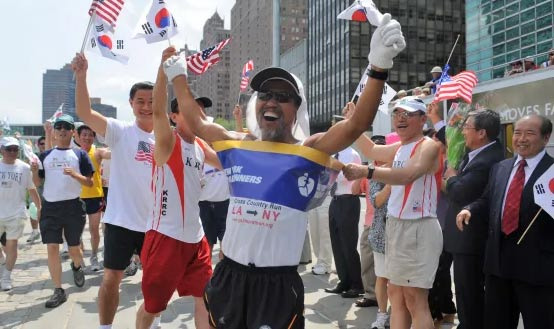
Mr. Kwon set off from Los Angeles on March 23, 2010, and after 95 days of running for 8 hours each day, he arrived in front of the UN headquarters in New York at 3 PM local time on the 25th. He became the first Asian to complete a transcontinental run across America.
As the first Asian and Korean to cross America by running, and at the age of 65, he left a very symbolic record.
Now, in my mid-40s (20 years younger than Mr. Kwon when he succeeded in crossing the continent), I believe that running from Los Angeles to New York involves significant risks in terms of climate, traffic, health, and economy, beyond just a physical challenge. Moreover, achieving success requires strict training, careful team support, and sufficient sponsorship or self-funding, making it a typically difficult endeavor.
What's even more amazing is that he prepared thoroughly for this challenge, and that preparation included not just physical fitness but also connections with many people.
Through his journey, Mr. Kwon aimed to promote the risks of diabetes, peace on the Korean Peninsula, and a message commemorating the 60th anniversary of the Korean War across America. He chose the UN headquarters as his destination for that very reason.
What made this story even more touching was the response from the marathon community in America.
Once Mr. Kwon's plan became known, marathon clubs across the country volunteered to run alongside him in segments.
Korean runners waiting for Mr. Kwon's schedule from Los Angeles, California to New York participated in the "March for Peace" by running together in their respective segments as if passing a torch.
Running may seem like a solitary sport, but in the end, there are always companions along the journey.
Some offer water, some match the rhythm beside you, and on some days, someone's footsteps lead your own.
Mr. Kwon Yi-joo's transcontinental run was not just a record of one person.
It was a 'record of solidarity' where the dreams of countless runners ran together.
His back running under the California sun, scenes of him greeting Korean runners along the way, truck drivers cheering him on and waving, and finally, his face smiling with arms raised in front of the UN headquarters in New York.
That was a symbol of the runner we all want to reach someday, a legend who ran for his own reasons without giving up until the end.
As a 44-year-old who loves marathon running, I want to express my deep respect.
And someday, I dream of being able to follow at least part of the path he ran with my own two legs.
To me, and to all of us, Kwon Yi-joo is the 'legend of runners.'







 novapixel |
 Peter Pan Pet |
 horse |
 Sunset Oregon |
 daisypat |
 Weekend Movie Blog |
 Beauty, Health, Lifestyle Blog |
 coloradoman |
 Superman Cat Blog |
 Awesome Blog |
  vibranto |
  Tora Tora |
  yellowbutter |
  Dolly |
  US Embassy |
  NYC saladbar |
  Finding Superfoods |
  lightyear |
  song bang |
  vexomo |
  Indiana Jones |
  meloncat |
  mortrix |
  Esther 1983 |
  fortbliss |
  Moscow Kim |
  My Two Way |
  toastyfox |
  FLORIDA Acus |