
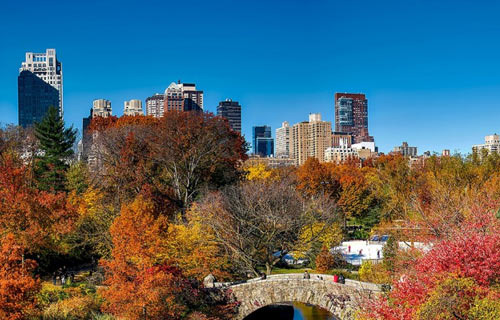
When you think of New York, you might picture tall buildings and the glitz of Manhattan, but living here reveals that it is a city with very distinct seasons.
New York City has a humid continental climate. The average annual temperature is around 13 degrees Celsius, and the annual precipitation is about 117 cm, which is quite significant. Interestingly, rain does not fall only in specific seasons. Spring, summer, fall, and winter all see rainfall, and weather changes are quite frequent.
Summers are much hotter than you might expect. Many people envision New York as a cool northeastern city, but July and August can be quite sweltering. Days often exceed 30 degrees Celsius, and during heat waves, temperatures can approach 35 degrees.
Manhattan, in particular, experiences a strong urban heat island effect. Concrete buildings and asphalt absorb heat during the day and continue to release it at night, making it hard for nighttime temperatures to drop. Conversations with people living in New Jersey or Long Island often reveal that even with the same weather forecast, the perceived temperature can feel different.
Additionally, New York summers are humid. It's not just hot; the heat is sticky. Waiting for trains on subway platforms is often cited as a quintessential hardship of summer life in New York. As a result, air conditioning is essential in most apartments and condos.
In contrast, winter shows another side of New York. The average high temperature in January is about 3 degrees Celsius, but strong winds can make it feel much colder. During Arctic cold snaps, temperatures can drop below -10 degrees.
Snowfall is also significant. The average annual snowfall is about 63 cm, but there can be considerable variation from year to year. Some years see little snow, while others experience multiple blizzards. There are instances where over 30 cm of snow can accumulate in a single day, leading to school closures or increased remote work.
However, New York is well-equipped to handle heavy snowfall. Snowplows and personnel are deployed on a large scale, so most major roads are quickly cleared. Still, commuters should be prepared for subway delays and traffic congestion the day after a heavy snowfall.
Personally, I believe that spring and fall are New York's most beautiful seasons. Spring retains a winter feel until March, but by mid-April, the atmosphere changes completely. Central Park bursts into bloom with cherry blossoms and various spring flowers, and street cafes begin to see people coming out.
Fall is the season that New Yorkers love the most. From mid-September, humidity drops, and a cool breeze begins to blow. October is often referred to as the golden period of New York weather. During the day, a light jacket is sufficient, and at night, it's pleasant to enjoy a walk in the cool air.
Not only is the fall foliage in Central Park stunning, but driving up to the northern Hudson Valley offers beautiful autumn scenery that rivals New England. Therefore, New Yorkers often head to the suburbs every weekend in the fall to enjoy the changing leaves.
For Korean families preparing to move to New York, seasonal preparations are important. In winter, padded jackets, warm shoes, and gloves are essential, while summer requires checking cooling systems. Families with young children especially need to plan for snowy days and heat waves.
Ultimately, while New York's weather can be inconvenient, it also offers the advantage of experiencing the charm of all four seasons.
 urban89








 My Town My Way Blog |
 Arizona AZ Cowboy |
 Valley Hong |
 Mr Oh |
 ollege Mom |
 newyorker 101 |
 Lunch and Dinner Mexican Taco |
 shinramen wang |
  International Court |
 Eating Gukbap and Working Hard Deer |
  ASURA |
  rapids |
  Softember |
  mykiwi blog |
  Maria Mom |
  Watch for possible danger |
  northpeak |
  Far East Movement |
  Light of the World |
  mariashin |
  lavender |
  Bridgo |
  Tamfa Fan |
  Sunny Sunday |
  mini hometown |
  torvia |
  Chichiki Chicago Train |
  Univ Student |
  See It |
  Con Cheese |